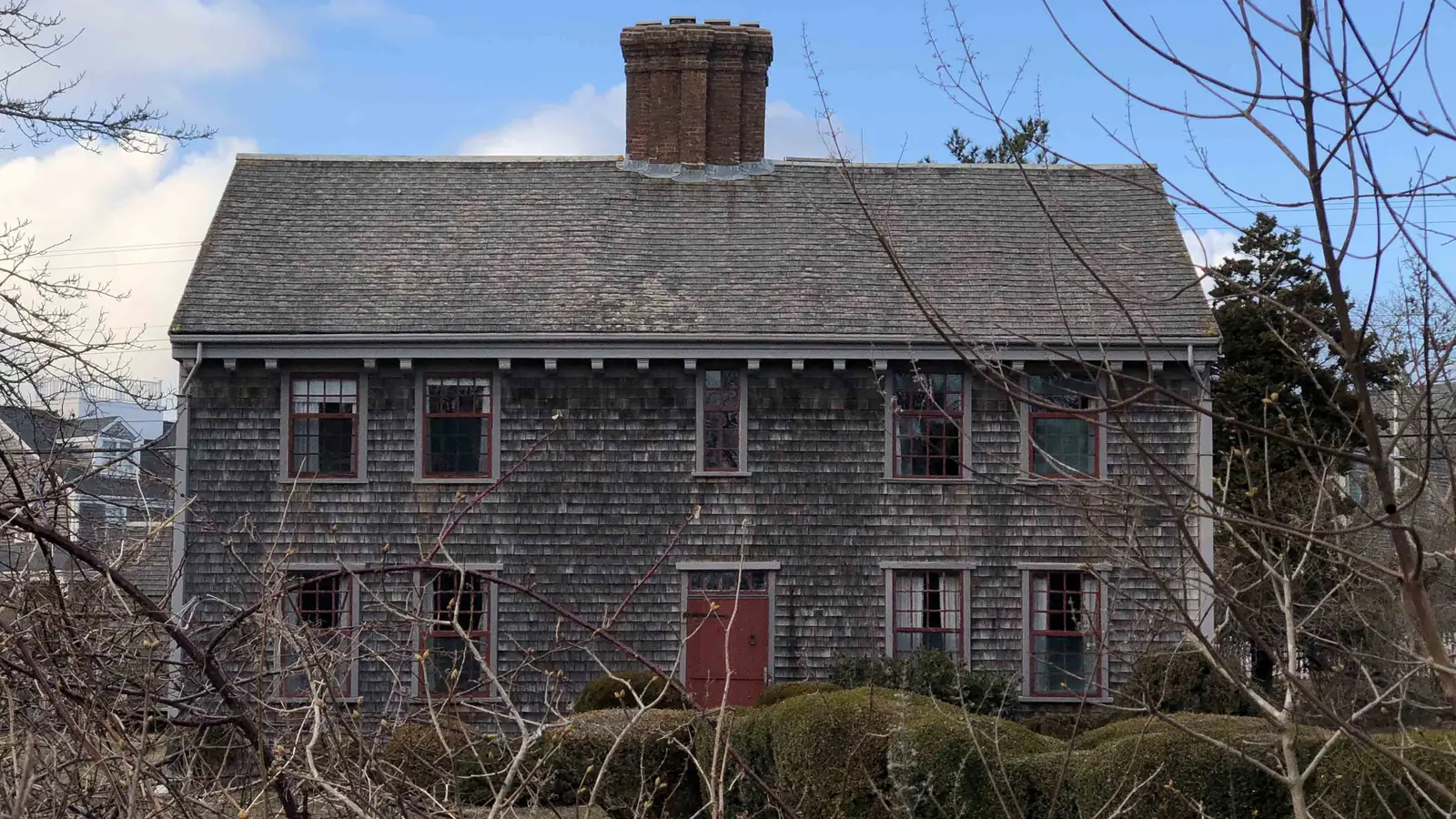
Ask someone to picture a Nantucket house and they'll describe the same thing without ever having set foot on the island: weathered grey shingles, white or dark trim, a widow's walk on the roof, maybe roses climbing a cottage wall. That image is remarkably consistent — and it is no accident. It is the product of three centuries of salt air, whaling money, Quaker restraint, and some of the strictest historic-preservation rules in the country. (The market side of that story — buying the real thing — is the historic-homes guide.) Here is what "Nantucket style" actually is, where it came from, and what it means if you're thinking of buying here.
Why do all the houses on Nantucket look the same?
The signature Nantucket house is clad in cedar shingles that start a warm tan and weather — over a season or two of sun and salt air — to the soft silver-grey the island is known for. It began as a practical choice. Cedar handles a marine climate well, and shingles were cheap and local; time is what turned a building material into an aesthetic. Add white or dark trim, simple gabled rooflines, multi-pane windows, and the occasional rooftop walk, and you have the vernacular that repeats, with variations, from the historic core of Town out to the farthest cottage in 'Sconset.
What makes it feel so coherent is that Nantucket is not imitating a style — it is the style. The town is a National Historic Landmark District, one of the most intact early-American towns anywhere, and the whole island has kept building in the same language ever since. When people talk about the "Nantucket look" being copied in Cape Cod developments or Hamptons builds, this is the original they mean.
Whaling wealth and Quaker restraint
The town you walk through today was largely built in the late eighteenth and early nineteenth centuries, when Nantucket was one of the richest ports in the world on the strength of the whaling trade. That money paid for the grand houses that still line Main Street and the streets around it — Federal and Greek Revival mansions built by whaling merchants and captains. The famous "Three Bricks," a matched row of brick Federal houses a merchant built for his sons, are the postcard version; the white-columned Greek Revival houses across the street are their neighbors.
But the dominant temperament of Nantucket architecture is restraint, and that comes from the Quakers who shaped the island's culture for generations. Quaker plainness discouraged ornament and display, and you can still read it in the symmetry, the simple lines, and the absence of fuss on so many Nantucket houses. Even the grandest homes here tend to be dignified rather than showy — a sensibility that has quietly survived into the way the island builds today.
'Sconset and the island's oldest houses
Drive to the eastern end of the island and the scale changes entirely. Siasconset — 'Sconset to everyone who lives here — grew up as a fishing and, later, an actors' colony, and its oldest cottages are among the earliest surviving structures on Nantucket, small and low and added onto over centuries. These are the rose-covered cottages that define the island's softer, more romantic image: tiny footprints, weathered shingles, and climbing roses that peak pink and red in early summer.
'Sconset's houses are a useful reminder that "Nantucket style" is not one thing. It runs from eight-figure Town mansions to cottages you could cross in a few steps — but the shared material palette, the restraint, and the deference to what came before tie them all together.
What defines Nantucket style architecture
If you're trying to recognize — or build — an authentic Nantucket house, these are the elements that matter:
- Weathered cedar shingles. The default cladding, left to grey naturally. Painted siding is the exception, not the rule.
- Restrained trim and color. White or dark trim against grey shingle; a limited, natural palette. You will not see bright or unusual exterior colors here, and that is by design.
- Simple, gabled forms. Symmetrical, honest rooflines rather than complicated silhouettes.
- True divided-light windows. Multi-pane windows with real muntins — a small detail that separates a genuine Nantucket house from an approximation.
- The widow's walk. The railed rooftop platform, a holdover from the whaling era. The romantic story is of wives watching for returning ships; the practical purpose was access to the roof and chimneys, and the view.
- Deference to scale and setting. Houses that sit comfortably in their surroundings rather than dominating them.
The rules behind the look: the HDC
Here is what surprises many buyers: the consistency is not just tradition, it is law. For more than half a century, the Nantucket Historic District Commission — the HDC — has had jurisdiction over the entire island, not just the old town. Any exterior change visible from a public way — new construction, additions, windows, doors, trim, even paint color and roofing — requires HDC review and approval before you can do it.
That is why a brand-new house in a mid-island subdivision still reads as unmistakably Nantucket: it had to. The HDC governs materials, color, scale, siting, window styles, and the details that add up to the island's character. It is one of the oldest and most comprehensive historic-district commissions in the United States, and it is the single biggest reason the island looks the way it does.
What HDC review means when you buy or renovate
For a buyer, the HDC is not an abstraction — it is a practical factor in what you can and cannot do with a property.
If you plan to renovate, expand, or build, your plans have to be drawn with HDC rules in mind from the very beginning. Retrofitting a vision to the commission's standards after the fact is far harder, slower, and more expensive than designing within them from day one. Approval takes time, and the details matter: the wrong windows or an out-of-character addition can send you back to the drawing board.
None of this is a reason to avoid buying here. It is a reason to go in informed. The same rules that constrain what you can do to your own house are the rules protecting the value of everything around it — the reason a Nantucket street still looks like a Nantucket street, and the reason island property holds its value the way it does. When you buy here, you are buying into that protection as much as into the house itself.
Historic district vs. mid-island
Not every part of the island carries the same weight of restriction in practice. Homes in the historic core of Town sit under the tightest scrutiny, where preserving the eighteenth- and nineteenth-century streetscape is the whole point. Newer mid-island neighborhoods offer more architectural variety and, often, more flexibility to build the house you want — but the exterior is still governed by the HDC, so even new construction speaks the island's visual language.
Understanding where a given property falls on that spectrum — and what it will realistically let you do — is part of buying well here, and it is exactly the kind of local knowledge that is hard to get from a listing photo.
Why the look is worth protecting
I grew up with these houses — sixth generation on this island — and I have watched buyers arrive expecting the rules to be an obstacle and leave understanding them as the point. The grey-shingled coherence that makes Nantucket feel like Nantucket is not nostalgia. It is the thing that has kept the island from becoming anywhere else, and it is a large part of why a home here holds its value the way it does.
If you're weighing a purchase and want a straight read on what a specific property is — historically, architecturally, and in terms of what the HDC will let you do with it — that is a conversation worth having before you fall in love with a house. It is the difference between buying the picture and buying the reality behind it.
Frequently asked
What is Nantucket style architecture?
Nantucket style is the island's shingled vernacular: houses clad in cedar shingles that weather to silver-grey, with white or dark trim, simple gabled forms, multi-pane windows, and often a rooftop widow's walk. It ranges from grand Federal and Greek Revival houses in Town to tiny rose-covered cottages in 'Sconset, unified by a restrained palette and a deference to the island's historic character.
Why are Nantucket houses grey?
The grey is weathered cedar. Shingles start a warm natural tan and, exposed to sun and salt air, turn silver-grey within a season or two. It was originally a practical cladding for a marine climate; over time it became the island's defining aesthetic — and today the Historic District Commission's rules keep new construction in the same natural, un-painted palette.
What is a widow's walk?
A widow's walk is the railed platform on the roof of many older Nantucket houses, dating from the whaling era. The romantic story is that wives watched for returning ships from them; the practical purpose was roof and chimney access and the view. Today they are a signature architectural detail of the island's historic houses.
What is the Nantucket HDC and what does it control?
The Historic District Commission is the board that reviews and approves exterior changes across the entire island — new construction, additions, windows, doors, trim, roofing, and even paint color. It has governed the whole island for more than half a century and is the main reason Nantucket's architecture is so consistent. Anything visible from a public way needs its approval.
Can I renovate or build a modern house on Nantucket?
You can renovate and build, but the exterior must satisfy the HDC, which keeps new work in the island's traditional visual language — so a fully modern exterior is generally not permitted where it would be visible from a public way. Interiors have far more freedom. The key is to design with HDC rules in mind from the start rather than trying to retrofit a plan to them later.
Do the historic rules apply to the whole island or just downtown?
The whole island. While the historic core of Town carries the tightest scrutiny, the HDC's jurisdiction is island-wide, which is why even newer mid-island and outlying neighborhoods still read as distinctly Nantucket.
Does the historic character affect a home's value?
Yes — positively. The same preservation rules that limit what you can change to your own house protect the character and value of everything around it. That island-wide consistency is a significant part of why Nantucket real estate holds its value so reliably.
Where do Nantucket house plans come from?
Most new houses here are drawn by architects and designers who work with the HDC regularly, to the commission’s published guidelines, Building with Nantucket in Mind. A stock plan can be a starting point, but the exterior — massing, roof pitch, window pattern, shingle cladding, trim — is adapted to pass review, so budget for that design work before you commit to a plan.