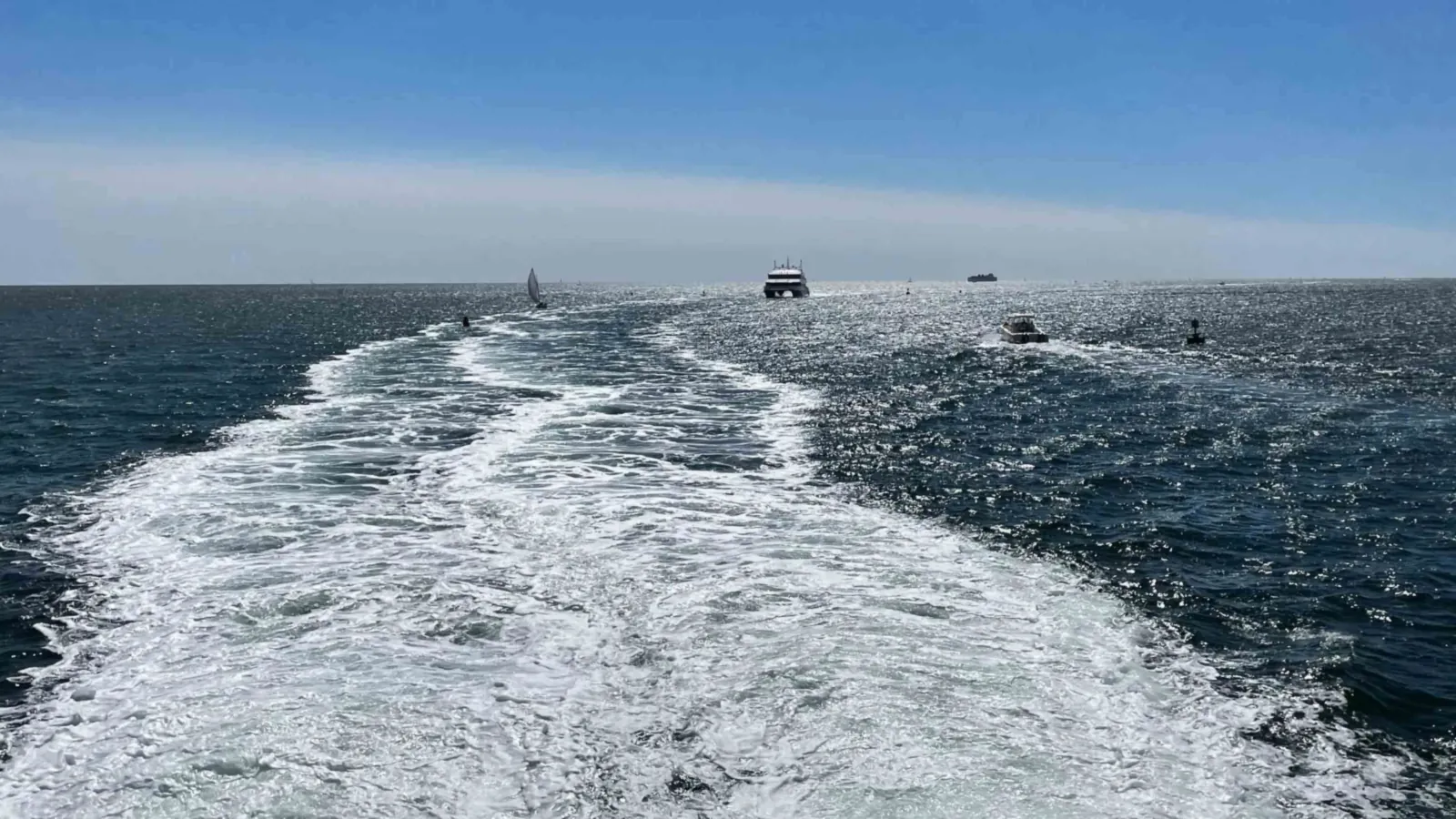
September is the heart of the Atlantic season out here. The owners who come through it well did their real work in June — and had already decided who was in charge.
Labor Day empties the boats and the island gets quieter, and then, most years, the weather starts paying attention to us. September and October are the busy end of the Atlantic season. Most of what reaches Nantucket arrives with its worst edges worn off — a tropical system that has curved out to sea and is throwing us its western side, or a nor’easter that decides to sit down offshore and stay a while.
I have watched a lot of owners meet their first real blow here, and the pattern is always the same. The people who have a calm week are not the ones who reacted well. They are the ones who did unremarkable work in June that they had mostly forgotten about.
Thirty miles of water changes the arithmetic
Everything about a storm here is shaped by the fact that we are a long way out. On the mainland, a bad forecast is an inconvenience. Here it reorganizes the week, because the things that fix problems — the crew, the part, the tree service, the adjuster — all have to arrive on a boat or a plane, and boats and planes are the first things the weather takes away.
So the island’s real storm sequence runs backwards from what visitors expect. The ferry stops before the wind is impressive. Contractors stop taking new calls a day or two before that. By the time the forecast looks genuinely serious, the island has already closed the door on outside help and is working with whoever and whatever is here.
That is not alarming. It is just the constraint everything else follows from, and the reason preparation here is worth more than it is almost anywhere else.
The work that matters happened months ago
The useful storm preparation is boring and it is seasonal, not reactive.
It is knowing your shutters actually fit. Storm shutters that have not been hung in three years have a way of not fitting the openings anymore, and finding that out in a rising wind is a bad evening. It is knowing where the shutters are stored and that the hardware is with them.
It is having your trees looked at by someone who knows what a nor’easter does to a limb that has been leaning the same direction for a decade. Most storm damage I see on this island is not the ocean. It is a tree, or a branch, or something that was on the lawn and then was not.
It is knowing the condition of your roof before the season rather than after it. And it is the drainage — where the water goes when a lot of it arrives at once, and whether the path it takes is still clear.
If you keep a caretaker, this is the conversation to have with them in the spring, not in the forecast. I go through the seasonal cadence of that relationship in the caretaking guide.
Two days out, the list gets short
When something is actually pointed at us, the work compresses into a handful of things.
Everything outside comes in or gets tied down. Furniture, umbrellas, the grill, the cushions, the things on the deck that have lived there all summer without incident. In a serious wind these stop being furniture and start being projectiles, and a teak chair through a window turns a dry house into a wet one.
Shutters go up while it is still pleasant. Boats come off moorings and out of the water, and the yards get busy in exactly the order you would expect, which is the argument for calling early rather than well.
Inside, the assumption is that the power will go and may stay gone. Devices get charged, the freezer gets left alone, and anything that depends on a pump — water, heat, a basement that stays dry because something is running — gets thought about honestly. If your house needs electricity to stay dry, you need to know that in advance and decide what you are doing about it.
And if you are leaving, leave early. The last boat before a storm is not a plan.
The morning after is mostly a documentation job
The instinct after a blow is to start cleaning up. The better instinct is to photograph everything first.
Walk the property before you touch it and take more pictures than feel necessary — the tree, the shingles, the water line, the ceiling stain, the fence. Then do the temporary work that stops the damage getting worse, because that is generally expected of you, and keep the receipts for it. Do not throw away what was damaged until someone who needs to see it has seen it.
Then get in the queue. After a real storm the island’s trades are triaging an entire island at once, and the call you make on the first morning is answered before the one you make on the third. That is not favoritism, it is arithmetic.
What your policy actually does at this point is a separate and genuinely complicated subject, and it turns on wind, flood and where your house sits. I have written out how flood zones and coverage work here in the flood zones and insurance guide and what island coverage costs and covers in the home insurance guide. The time to read them is now, not while you are standing in a wet room.
If you are off-island, which most owners are
Most of the houses I look after belong to people who are somewhere else in September, and that is fine, as long as somebody here is authorized to act.
That means a named person with keys who can get to the house without calling you first, because the phones may not work and you may not be awake. It means that person knowing where the water shutoff is, where the electrical panel is, and where the shutters live. And it means they can spend money on your behalf up to some number without waiting for approval, so that a tarp goes on a roof at eight in the morning instead of at four in the afternoon.
The owners who come through storms well are almost never the ones who were watching the radar most closely. They are the ones who had already decided who was in charge.
The other half of the season
I do not want to leave this sounding grim, because September and October are the best months here and the weather is a small tax on them. The island empties out, the water is still warm, the light gets long and low, and the town becomes usable again. Most of these weeks are simply beautiful, and the storm that reorganizes your week is the exception rather than the rhythm.
But it is a real part of owning a house thirty miles out, and it rewards the people who take it seriously in advance and then get to stop thinking about it.
If you own here and you are not sure your house is set up for the season — or you are buying and want to understand what you would be taking on — call me at 508-228-4578. It is a short conversation and a good one to have in September rather than October.