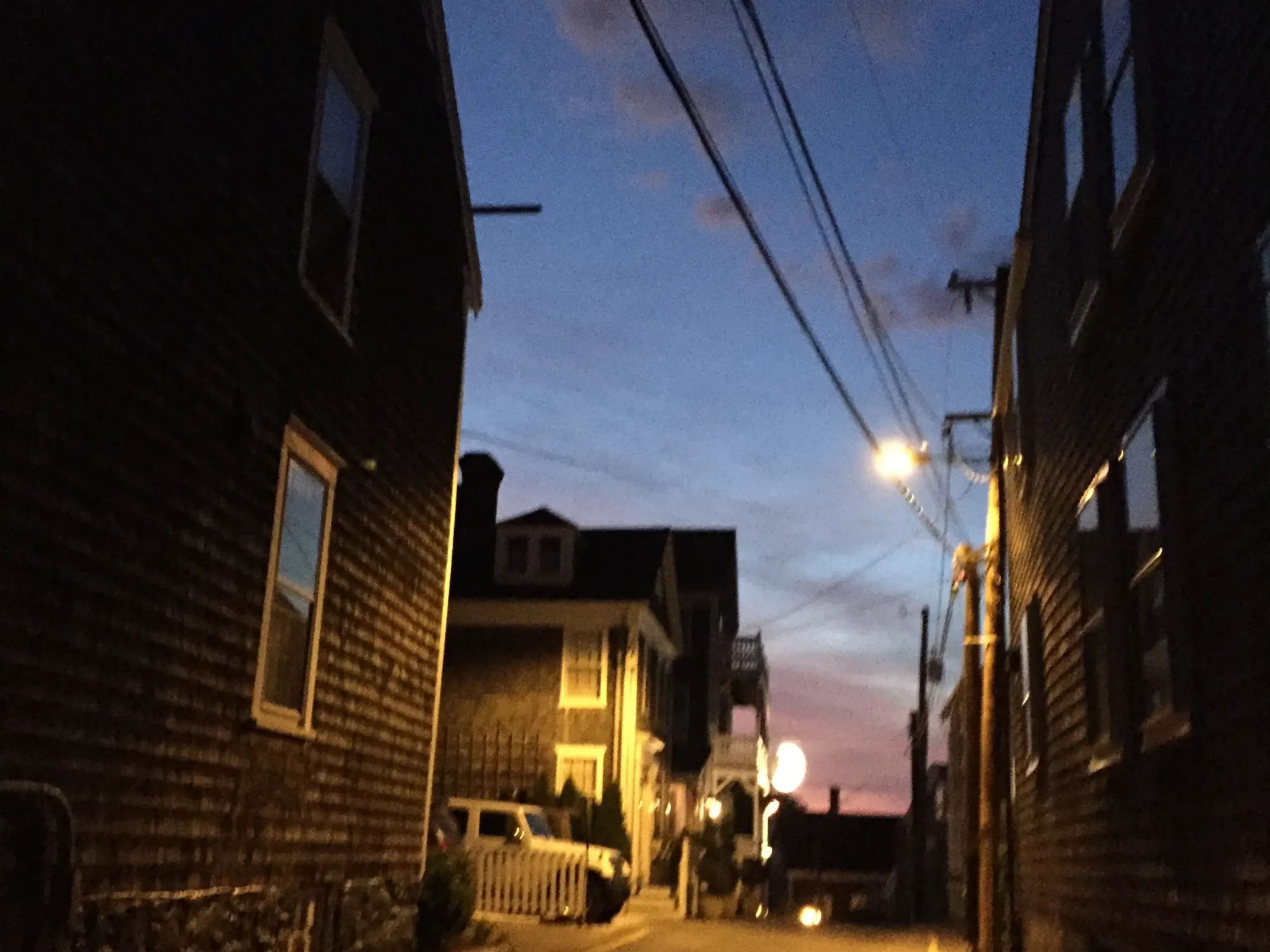
Every few nights this month, a guide leads a line of flashlight-free strangers up from Centre and Main into the dark, and for eighty minutes the oldest streets in town belong to them. The route hasn’t changed in years. Neither, mostly, has what’s on either side of it — and that’s not an accident.
Why this walk still looks like 1840
The Nantucket Ghost Walk runs several nights a week through Halloween, in two versions — a Cemetery Route and a Town Route — and the Town Route is the one worth a real-estate detour. It starts at 8 p.m. at the top of Main Street, at the corner of Centre and Main, and covers about a mile of the historic core in roughly eighty minutes, past five stops the guides keep to themselves until you’re standing in front of them.
What the walk is actually selling is atmosphere, and the atmosphere is real because almost nothing on that mile has been allowed to change. Main Street’s cobblestones, the brick storefronts, the captains’ houses set close to the sidewalk — all of it looks close to how it looked when whaling money built it, because a Nantucket institution has spent seventy years making sure of exactly that.
The rule that runs underneath every porch light
Nantucket created a local historic district in 1955, one of the first in the country, covering the old town core and 'Sconset. A special act of the state legislature — chapter 395 of the Acts of 1970 — extended it to the entire island. The federal government followed: the district was named a National Historic Landmark in 1966 and expanded in 1975 to cover Nantucket, Tuckernuck, and Muskeget together, which the town’s own guide to the rule calls the largest historic-district landmark of its kind in the continental United States. (Source: thekalmanco.com/nantucket-hdc-guide.)
The commission that enforces it is five elected residents, unpaid, on rotating three-year terms, meeting every Tuesday at 4 p.m. Nothing that touches a building’s exterior — a new roofline, a window swap, a fence, a pool, a different shade of paint — gets built without a Certificate of Appropriateness from that room first. Paint colors come from a long-standing island palette; a color outside it generally needs historical evidence to defend it. Demolition needs its own approval, and the commission can simply say no to tearing down something it considers historically significant. Skip the process and the fine runs three hundred dollars a day. (Source: thekalmanco.com/nantucket-hdc-guide.)
Walk the Ghost Walk route and you are walking through the result of thousands of those Tuesday decisions, most of them boring, none of them optional.
What that means for the house, not just the street
I’ve shown houses on the Ghost Walk’s own mile, and buyers almost always ask the same question backward: not “what can I change,” but “what’s going to stop my neighbor from changing anything.” The honest answer is the same commission that will slow down their own renovation. That trade — slower permits for a street that can’t be ruined underneath you — is the actual product in town, and it’s why in-town and 'Sconset listings carry a premium that has nothing to do with square footage.
It also means diligence here looks different than it does further out. Before you fall for a facade, find out what’s actually been approved behind it: additions, window replacements, decks, solar — anything added after the fact without a Certificate of Appropriateness is a problem for the next owner, not the current one, because the commission’s authority doesn’t expire at closing. A pre-offer call to the building department, or to us, about a property’s HDC history is worth more than another walk-through.
The three-generation argument for buying here
The practical case for a historic-district address is simple: the thing you’re paying for — a streetscape that still looks like the postcard — cannot be voted away by the next owner three doors down, or the one after that, or the one after that. Every exterior decision on that block has gone through the same room since before most buyers were born, and it will keep going through that room long after they’ve sold. That’s a different kind of durability than curb appeal, and it’s the reason a cobblestone address tends to hold its character — and its value — through market cycles that move faster everywhere else on the island.
If you’re weighing an in-town or 'Sconset property against something with more room to change, it’s worth talking through what the historic-district rules will and won’t let you do before you write an offer, not after. I’m glad to walk through a specific address with you — no pressure, no obligation.