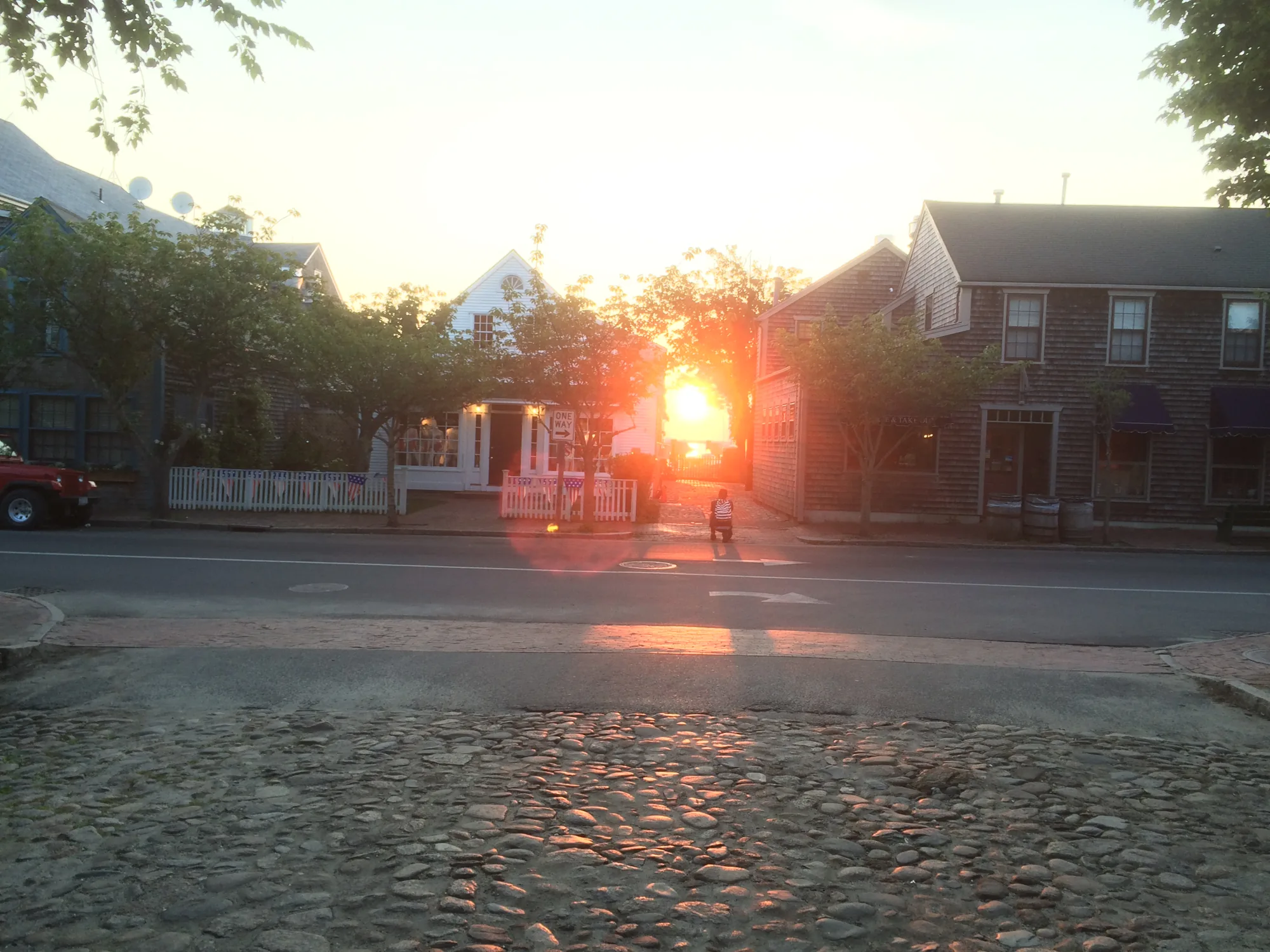
Ask a buyer in July whether they’d rather be near the beach or near town, and the beach wins every time. Ask again on a Saturday in late September, when the farmers market on Cambridge Street sets up for another week with half the tourists and all the same neighbors, and the answer gets more interesting.
The stalls that stayed
By late September, most of what made Nantucket feel crowded in July has thinned out. The ferry lines are gone, the rental turnovers have slowed to a trickle, and a lot of the restaurants that ran two seatings a night in August are back to one. But on Saturday mornings, Cambridge and North Union streets still fill in exactly the same window they did all summer: 8:30 to 12:30, tables out, crates of late-season produce and baked goods and whatever a given vendor still has coming out of the ground. The hours haven’t changed. What’s changed is who’s standing in line.
In August, that line was a mix of renters filling a week’s grocery list and locals ducking in early to beat the crowd. In late September, it’s almost entirely the second group. A market that runs the same hours through the shoulder season isn’t performing for tourists anymore — there aren’t enough of them left to perform for. It’s running because enough people who live here, in town, year-round, still walk to it. That’s a different kind of evidence than a summer crowd photo, and it’s the kind that actually tells you something about a neighborhood.
It’s run by a local nonprofit, Sustainable Nantucket, rather than a promoter, which is part of why it doesn’t need a summer crowd to justify itself. Nobody is trying to hit a revenue number on a Saturday in late September. The vendors who keep showing up are the ones with something to sell and somewhere to be on a Saturday morning regardless — which is a fair description of the in-town customer base they’re actually selling to at this point in the year.
What “walkable” actually buys you in October
Every listing near the center of town gets described as walkable, and in July that word doesn’t mean much — everything is walkable when the whole island is out and about. The test that matters is what’s still true once the season empties out. Can you walk to a real Saturday morning, not a shuttered storefront with a paper sign about winter hours? Can you get coffee, produce, and a conversation with someone you actually know, on foot, in the same forty-five minutes, in the last week of September?
That’s the version of in-town living that holds its value: not proximity to attractions that only run in summer, but proximity to the handful of things that keep running when summer doesn’t need them anymore. A house eight minutes from the market by car might be a perfectly good house. A house six minutes on foot from a Saturday morning that survives past Labor Day is buying into something else — a daily rhythm that doesn’t take a season off.
The neighborhoods this favors
This isn’t an argument for downtown over everywhere else on the island; plenty of buyers want the opposite of foot traffic, and Nantucket has room for that too. But for anyone weighing an in-town address specifically for its convenience, late September is the honest test, the same way an empty street in October tells you more about a neighborhood than a full one in August does. A market that’s still setting up on the same corner, at the same hours, with a smaller but steadier crowd, is a sign the in-town fabric isn’t seasonal decoration — it’s infrastructure that happens to look festive in summer.
Walk the same three or four blocks in late September that you’d walk in July. Notice what’s actually open, not what has a pretty storefront. The gap between those two lists is the real difference between a house that’s “near town” on a map and a house that’s near town in practice, in March as much as in August.
This is also where the case for in-town living gets more specific than “convenient.” A five-minute walk to a market that survives the shoulder season is a five-minute walk to a small, steady piece of daily life — not a five-minute walk to a strip of shops that reopens each May like a stage set. Buyers comparing two otherwise similar houses rarely ask which one is closer to something that’s still running in late September. It’s worth asking, because the answer tends to sort the neighborhoods more honestly than square footage does.
What to check before you assume
Before you let a market stall or two stand in for the whole picture, do the same walk at a different hour — a Tuesday afternoon, not just a Saturday morning — and see what’s actually running. A single Saturday market surviving into fall is a good sign, not a guarantee; check it against what else is open nearby, and ask your agent how far that pattern extends beyond the one visible weekend ritual. The value in an in-town address isn’t the market itself. It’s everything the market’s survival tells you about the streets around it.