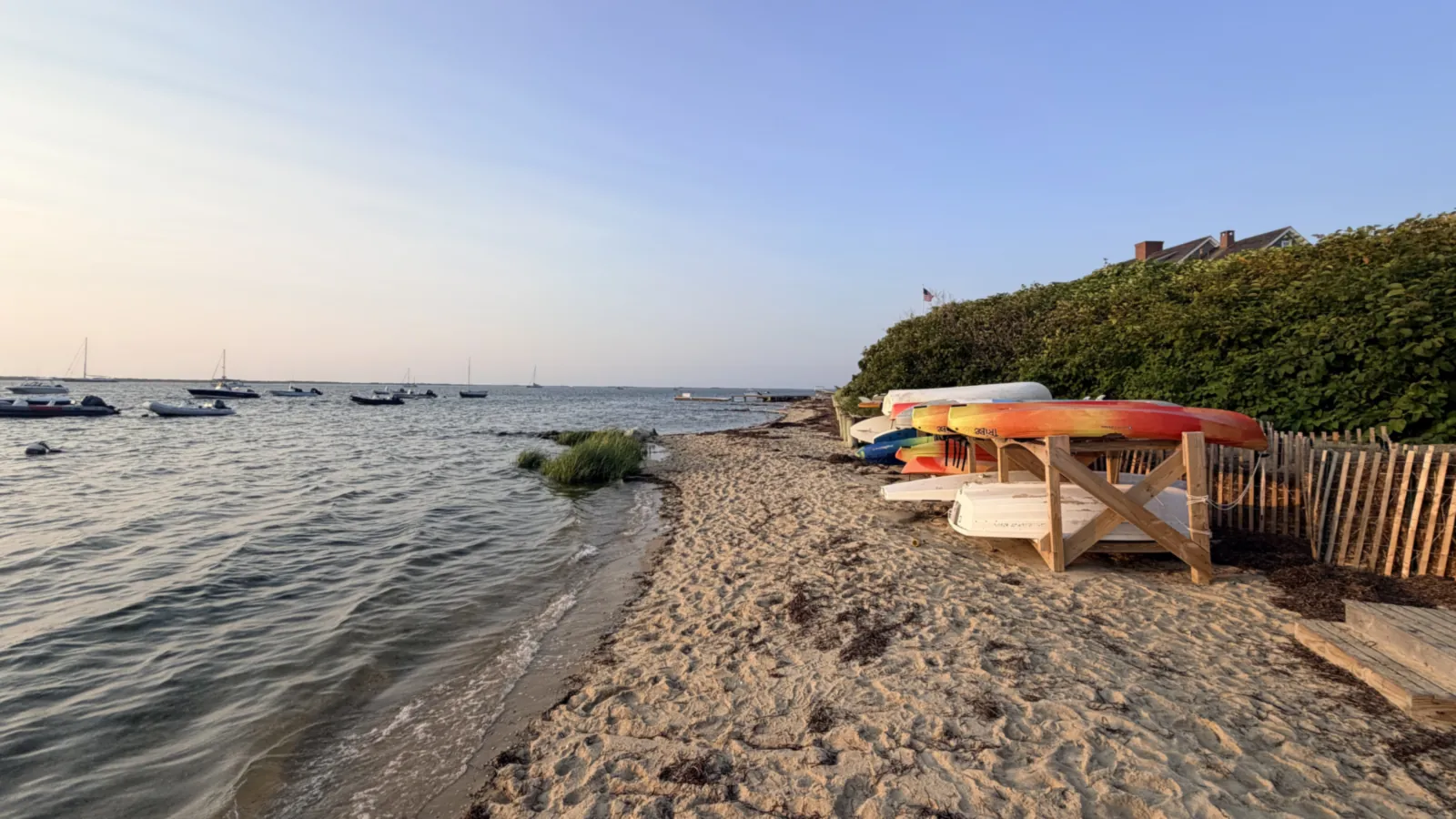
Family scalloping opened October 1 and runs Wednesday to Sunday until the end of March. How the season works, what the permit costs, and why the same shellfish beds shape what you can do with a harbor house.
Every fall the harbor changes hands twice. On October 1 it opens to recreational scallopers, the people this island has always called family scallopers, out in the shallows with waders, a rake and a basket. On November 1 the commercial season starts, and the boats work every day but Sunday.
That gap is the best thing about October here. For one month the bay scallop belongs to anyone with a permit and a free afternoon.
The rules fit on an index card
The calendar. October 1 through March 31, Wednesday through Sunday only, from half an hour before sunrise to half an hour before sunset.
The limit. One bushel per permit per week, measured level.
The size. Adults only. A keeper has a well-defined growth ring. A fall-spawned nub, whose ring sits less than 10 millimeters from the hinge, is legal only if the shell stands at least two and a half inches tall. A scallop with no ring is seed, and seed goes back.
The shell. Everything comes ashore in the shell, so the shucking happens at home.
The permit knows who lives here
Everyone 14 and older needs a recreational shellfish permit and has to display the button while working. Children under 14 can go along with a permit holder, and whatever they rake counts toward that adult’s bushel.
The Town lists four prices: $35 for a Nantucket resident, free for residents over 60, $125 for a non-resident for the year, and $50 for a non-resident week. Apply online, or in person at the Public Safety Facility on Fairgrounds Road, weekdays from 8 to 4.
Here is the part that surprises new owners. The Town’s shellfish regulations define a resident as someone whose domicile and legal residence is Nantucket, documented the way you would expect (voter registration, car registration, driver’s license, income tax filings) and held for one full year. A deed is not on that list. Owning a house here, on its own, puts you in the non-resident line.
That isn’t a slight. It is a small, honest marker of a bigger decision: if you move here full time, the scallop permit is one of the first places it shows.
One more rule catches people the following fall: every permit holder files an annual catch report for the year ending March 31, and a new permit waits until it’s in.
Where people go, and what the harbor asks
The Nantucket Shellfish Association suggests starting in Madaket or off Monomoy. Snorkelers need a dive flag for each person in the water, within 100 feet, and the permit pin on them, not on the beach.
Watch for the red flag. When the fishery closes, for air colder than 28 degrees or a scallop stranding among other reasons, the Shellfish Warden raises one at the Town Pier and at Jackson’s Landing in Madaket.
And if your house has a dock, the catch can’t spend the night hanging off it: the Town prohibits holding a recreational catch in Nantucket waters for any length of time.
For a guided first round, the Maria Mitchell Association is running scalloping field trips in Nantucket Harbor this month, with waders and hand nets supplied, for adults and children 13 and up. You still need your own permit to bring scallops home.
The same beds set the rules for a harbor lot
This is where scallop season stops being a pastime and becomes a property question.
The flats families wade in October are a protected resource under the Town’s wetlands regulations. The Conservation Commission presumes that land containing shellfish, and land within 100 feet of it, is significant. Septic leach facilities have to sit at least 100 feet from it. Projects can’t obstruct the public’s ability to gather shellfish, and no project detrimental to scallops is permitted without a waiver.
The zoning bylaw adds its own line: new docks, piers and wharves are prohibited on shorefront land in every district, with a few narrow exceptions, mostly public and commercial. An existing dock can be maintained or replaced like for like; reconfiguring one takes a special permit and can’t add to its footprint.
The harbor watersheds carry wastewater rules too. In the Nantucket Harbor Watershed Protection District, a property off the sewer has to install a state-approved nitrogen-reducing septic system on transfer, and Madaket’s harbor watershed zones carry a parallel rule. The Title 5 guide walks through how that plays out in a sale.
None of this is a reason not to buy on the harbor. It is the reason the harbor is still worth buying on.
What I check before a client buys on the water
The Conservation Commission file. Every Order of Conditions on the property, and whether each was closed out with a Certificate of Compliance. An open order is easier to resolve before closing than after.
The septic, and where it sits. Its distance from the flats, and whether the lot falls inside a harbor watershed district.
What the dock really is. If there is one, confirm it is a lawful pre-existing structure. If a listing hints at dock potential, ask hard questions; the waterfront guide explains why.
How you reach the water. A harbor view and a way down to the water are two different things. Ask whether the house has frontage, a deeded right of way or an association path.
The October house. An outdoor shower, a hose by the door, somewhere for waders to drip, and a counter big enough to shuck at. The houses that live well in scallop season are the ones that planned for sand.
Questions I hear every October
When is recreational scallop season on Nantucket?
October 1 through March 31, Wednesday through Sunday only. The commercial season opens November 1.
How much does a Nantucket shellfish permit cost?
$35 for residents, free for residents over 60, and $125 a year or $50 a week for non-residents. Everyone 14 and older needs their own.
Does owning a house on Nantucket make me a resident for the permit?
Not on its own. The Town’s shellfish regulations define a resident by domicile and legal residence held for a full year, shown through records like voter registration or income tax filings.
If you are looking at a house on the harbor this fall and want the Conservation Commission file read before you fall for the view, I’m at sean@thekalmanco.com.