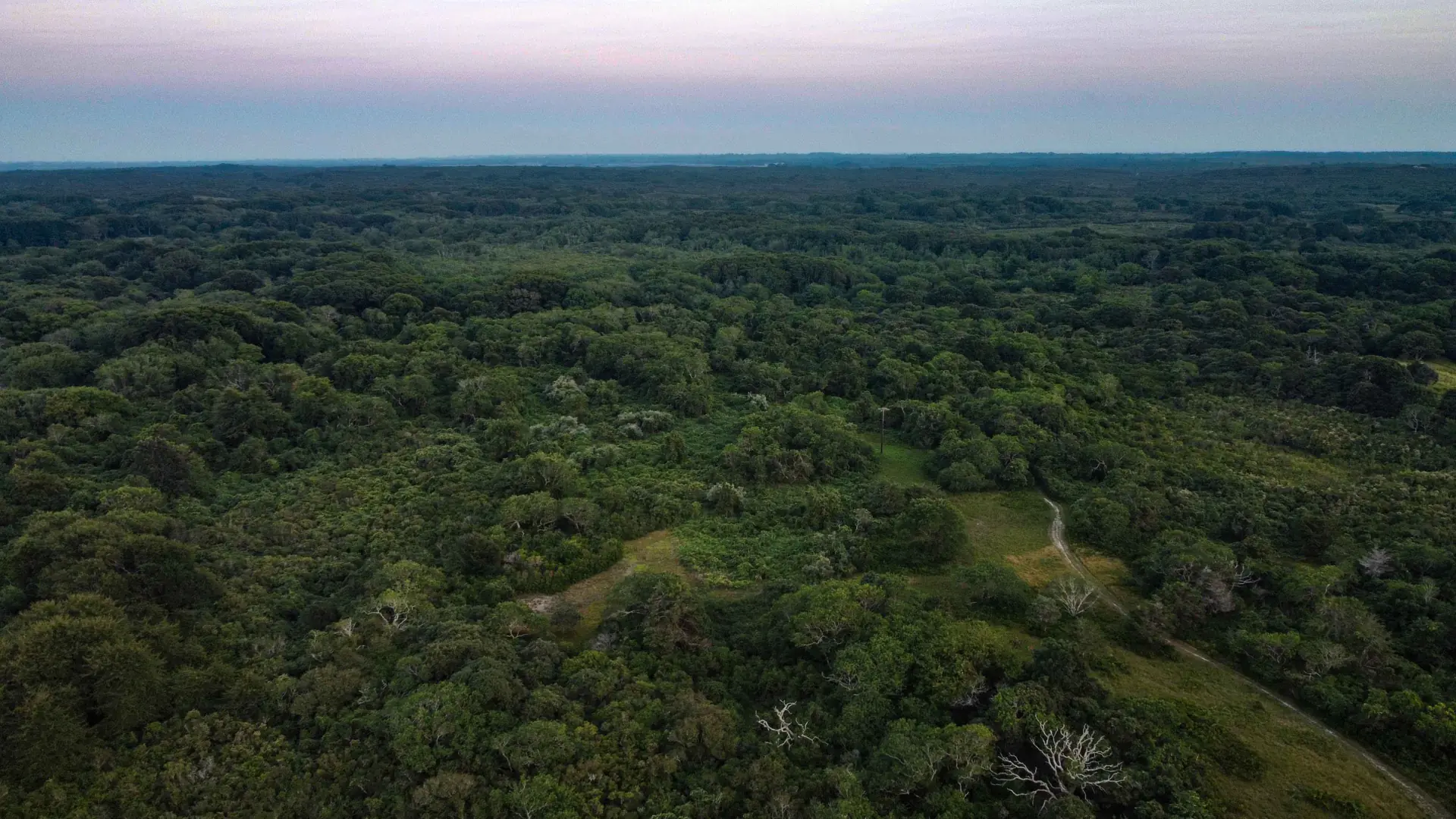
This Saturday, hikers set off from Tom Nevers and walk to Madaket Harbor — all the way across the island, mostly on land that will never be built on. That the route exists at all is the single most useful thing a buyer here can understand.
The walk that crosses the whole island
The Nantucket Islands Land Bank holds its Cross-Island Hike on Saturday, September 19, starting at 8:00 am from the beach at the end of Tom Nevers Fairground and finishing at Settler’s Landing on Madaket Harbor. East end to west end, on foot, in a day.
Sit with what that actually requires. On most resort islands a coast-to-coast walk would be a road march — a long day on pavement with driveways on both sides and somebody’s hedge for scenery. Here you can cross largely on open ground, because a remarkable share of the land between those two points is owned by organizations whose entire purpose is to keep it exactly as it is.
Who owns the ground you’d be crossing
The Nantucket Conservation Foundation owns and maintains 9,011 acres spread across 218 parcels — “nearly 1/3 of Nantucket,” in the Foundation’s own words. Its largest single holding is the Middle Moors at roughly 3,200 acres, a good share of what you’d cross in the middle miles of Saturday’s route.
The Land Bank is the public half of the same project. It was created by a special act of the Massachusetts Legislature in 1983, the first land bank of its kind in the country, and it is funded by a two percent fee levied on most real estate transfers on the island. Every closing here helps buy the next piece. Add the ’Sconset Trust, Mass Audubon, the Trustees of Reservations and the town’s own holdings, and by the Land Bank’s own summary, nearly half the island is now permanently protected open space.
So the hike is not a trail someone laid out for a nice morning. It is the visible result of five decades of quietly buying land and declining to build on it.
The rest of the week belongs to them too
Saturday is the headline, but look at the whole week and the pattern holds. Almost everything on the island’s calendar right now is being run by the same handful of organizations.
The Nantucket Preservation Trust runs its Main Street walking tour Tuesdays at 3 pm through September 29, meeting at 11 Centre Street, and its historic ’Sconset tour Thursdays at 3 pm through September 24, meeting at 1 New Street. The Linda Loring Nature Foundation has a guided walk at Ruddick Commons with the ’Sconset Trust on Tuesday morning, its free birding field trip on Wednesday morning departing from the LLNF office at 110 Eel Point Road, and a Friday walk on climate impacts at its own property.
Between conservation and preservation, that is the complete answer to why Nantucket looks the way it does — what stays open, and what the built parts are allowed to look like. For one week in September, both are running public programs, and most of them are free.
What any of this has to do with what you’d pay
Two things, and they are not small.
The first is arithmetic you can feel. Buildable land on an island this size was finite before any of this started. Every acre the Foundation or the Land Bank takes permanently off the table makes what remains a little rarer — and the mechanism is funded by the transactions themselves. That two percent on your closing statement is not a tax that disappears into a general fund. It goes to buying the next parcel.
The second is what it does to an individual lot. “Abuts conservation” is the most durable amenity on this island, and it is worth more than any feature you can build. A hedge can come down. A neighbor can tear off the back of the house and put up something taller. A moor held by the Foundation cannot do either of those things, ever.
It is not free of trade-offs, and I would rather you hear them from me. Protected land is managed land: mowing, brush cutting, prescribed burns and organized deer hunts are all real work that happens on schedule. It is also public land, which means walking trails can run closer to your property line than you assumed. For most buyers that is a fair exchange for a neighbor who will never build. For a few it is worth knowing before, not after.
If you’re looking at houses this week
Four things worth doing while the island is in this mood.
Walk a leg of Saturday’s route, even if you skip the full crossing. Nothing on a listing sheet explains the island’s scarcity as fast as covering a few miles of it on foot.
On any lot you are serious about, ask three questions in order: what abuts it, who holds that abutting land, and under what instrument. A Foundation moor, a Land Bank beach lot and a town watershed parcel are three different neighbors with three different publics.
Ask specifically whether a public trail runs near the property line, and walk it if it does.
And budget the Land Bank fee from your first conversation rather than your last. It is two percent of the purchase price, by statute the buyer’s to pay, and it is due at closing — on a three million dollar house that is sixty thousand dollars that should never be a surprise.
None of this is decoration. The openness that sells the island to you is owned, deliberately, by people who are walking you across it this week. Go see what you would be buying next to.