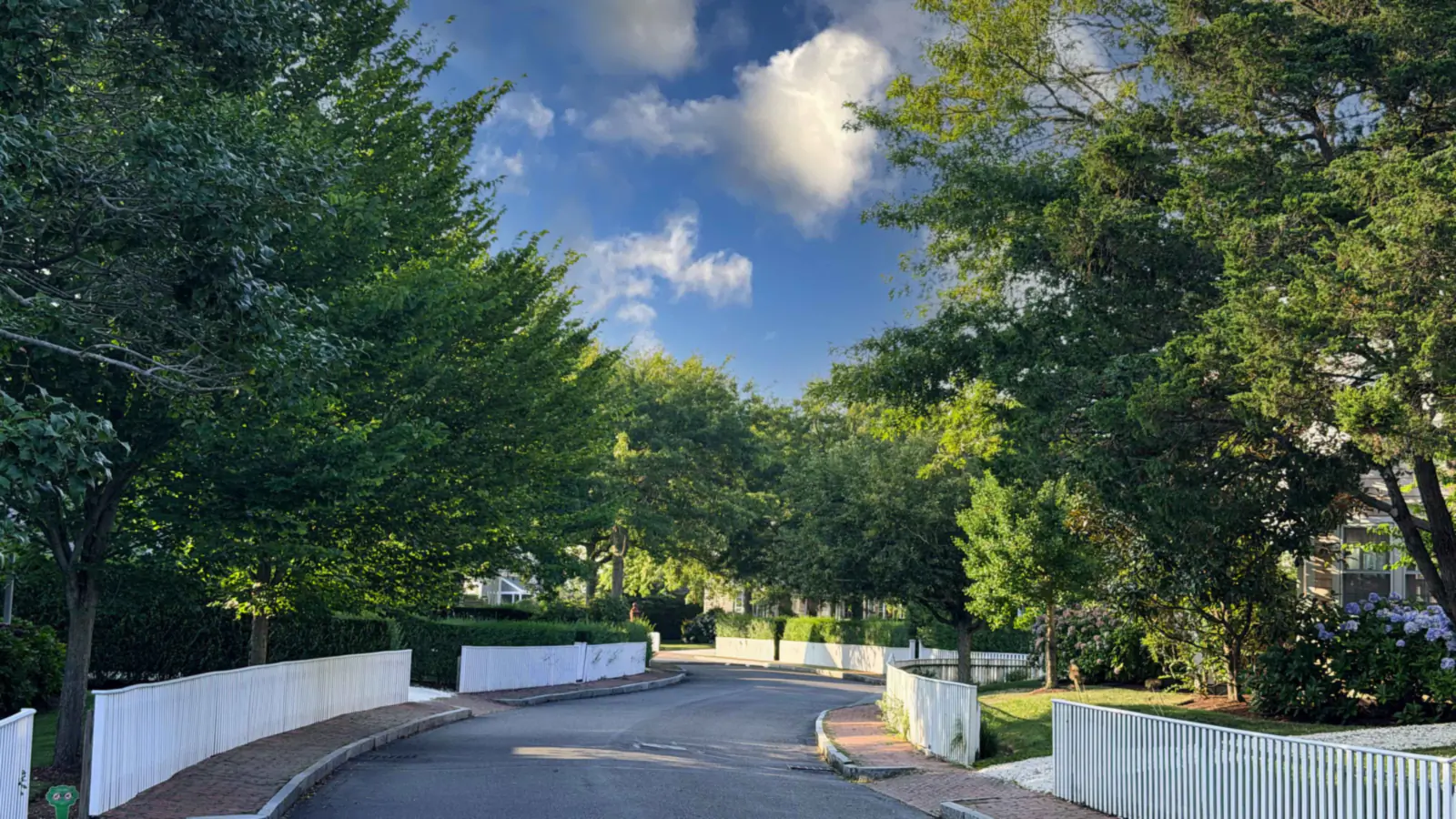
Every September the island quietly runs an honesty test on its own neighborhoods. It costs nothing to take, you can only take it for about six weeks, and it tells you more than a bright Saturday showing ever will.
The month the island stops performing
In August every street on Nantucket is doing its best work. Cars in the driveways, bikes on the lawn, somebody’s dinner happening on a porch, every window lit. You cannot tell a year-round lane from a street that is fully awake eleven weeks a year, because in August they look identical. That is the point of August.
Then the ferries thin out, the rentals end, and over the space of two or three weeks the island sorts itself. Drive any street after dinner in late September and you learn something it spent all summer hiding: how many of these houses are lived in when nobody is watching.
I grew up here, so I have never really stopped reading streets this way. It is the first thing I do when a client asks me about a neighborhood, and it is the one piece of due diligence that requires no permission, no appointment and no one’s cooperation.
What a dark window actually tells you
Nothing about the people. Everything about the rhythm.
A street where most windows are dark in October is a summer street, and summer streets have real virtues. They are quiet in the off-season in a way that is genuinely restorative. They tend to be closer to the water. The houses are often newer or more recently rebuilt, because the economics of a seasonal house and a year-round house are different and they produce different buildings.
A street where the lights are on in October is a year-round street. Something is always happening on it. There is a truck parked badly somewhere. The plow comes through first, the cable company shows up faster, and if a pipe lets go in February somebody notices before you do.
Neither of these is the right answer. They are simply two different things to own, and almost every buyer I work with has a strong preference once they have actually stood on both kinds of street in the same week. Very few of them knew it before they did.
What you only hear in the quiet
The test is not only about light. September strips the noise out and leaves the things a house will actually sound like for nine months of the year.
You can hear the airport from more of the island than you would guess, and you cannot hear it at all over a July crowd. You can hear which way the wind comes at the house, and whether the trees around it were planted for that or in spite of it. You can hear a bar’s last call carry four streets in still air. You can hear, on some lanes, absolutely nothing at all, which is either the thing you have been looking for your whole adult life or slightly more solitude than you bargained for.
Parking sorts itself out too. A street that swallowed eleven cars in August turns out to have three spaces, and whether that matters depends entirely on which house is yours.
Two kinds of good
The mistake is treating this as a hierarchy. It is not. It is a question about what you want the place to be when you are here in November.
Some owners want the island to be an escape from the version of their life that has neighbors in it. They should buy on a quiet lane, understand that they are also buying a house that sits empty and needs somebody reliable checking on it, and budget accordingly.
Other owners discover that the thing they actually love about Nantucket is being known — the same faces at the post office in February, the plow guy who waves, a street that still has something going on at it in January. They should buy where the lights are on, and accept a little more traffic past the window in exchange.
Both of those are good outcomes. The bad outcome is finding out in your second winter that you bought the other one.
Take the test this fall
You have until about the first week of November before the island goes properly dark and the test stops being informative, so here is how I would spend the next six weeks if you are seriously looking.
Pick your two or three candidate neighborhoods and drive each one twice: once around seven in the evening, once on a weekday morning around eight. Evening tells you who is here. Morning tells you who is going to work.
Get out of the car at least once. Stand on the street for five minutes without your phone and just listen. It feels slightly ridiculous and it is the most useful five minutes in the whole process.
And if you find a street you love, come back to it on a genuinely miserable night — rain sideways, nothing open. That is the island at its least flattering, and if the street still looks like home to you in that weather, you have your answer.
The houses will still be there in the spring. The information will not.