Nantucket vs. Martha's Vineyard: the real estate decision, honestly
The fork in the road
Every year, a set of buyers sits at the same fork: Nantucket or Martha's Vineyard. Both are extraordinary. Both will absorb as much capital as you'd like to deploy. And they are far more different — as markets and as ways of life — than the ferry map suggests.
We sell Nantucket, so you know where we stand. But the comparison below is built on published numbers from both islands, because the honest version is more useful to you: sometimes the Vineyard genuinely is the right answer. Here's how to tell which buyer you are. If you'd rather talk it through, tell me what you're weighing and I'll give you a straight read.
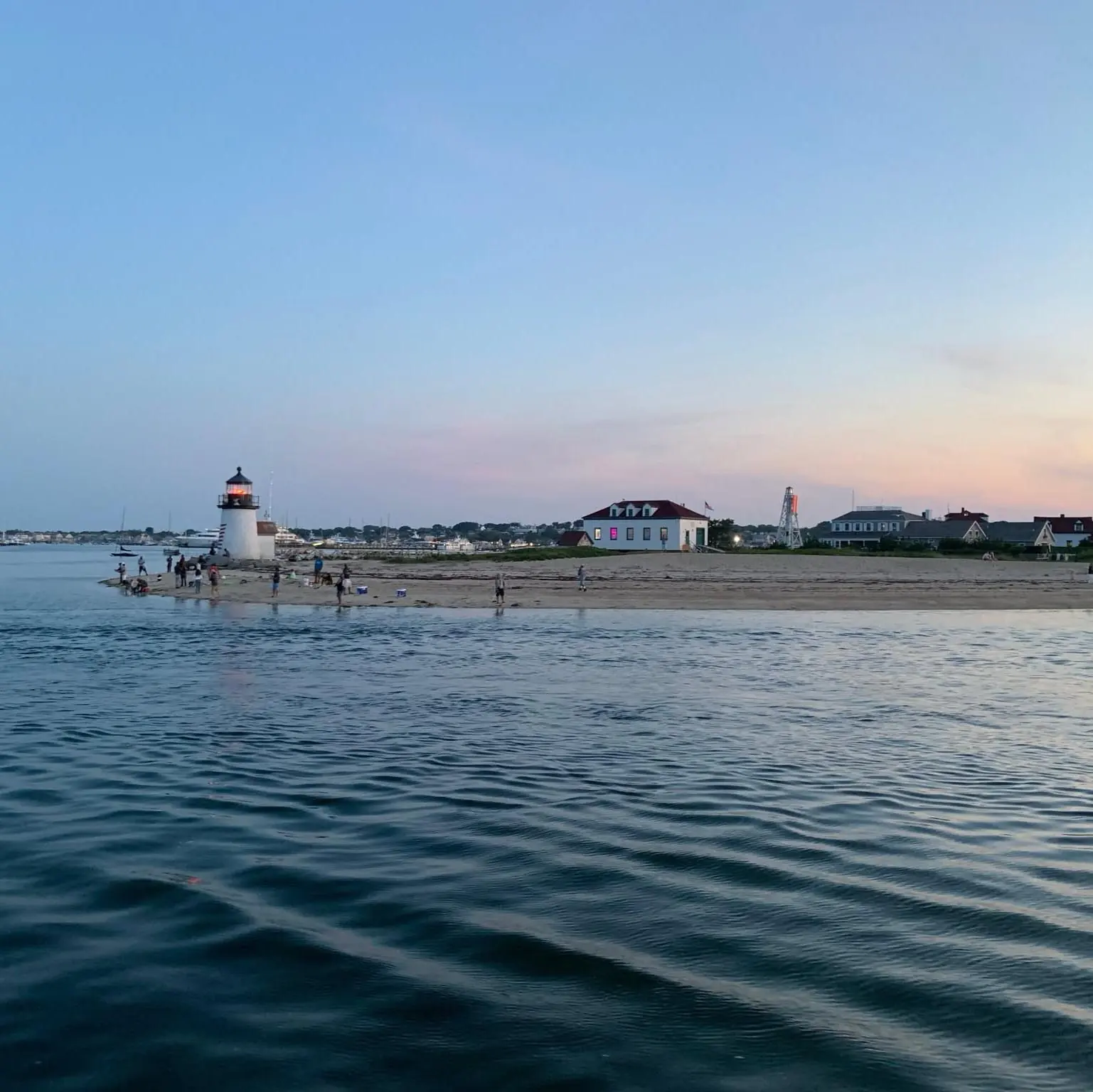
The structural difference everything else flows from
Martha's Vineyard is six towns. Nantucket is one.
The Vineyard — roughly twice Nantucket's land area, with about 20,000 year-round residents to Nantucket's ~14,000 — is a federation: Edgartown, Oak Bluffs, Tisbury, West Tisbury, Chilmark, and Aquinnah, each with its own government, tax rate, and rulebook. Nantucket is a single consolidated town and county: one Town Meeting, one zoning code, one tax rate, one Historic District Commission covering every parcel on the island.
Neither structure is better in the abstract, but they produce different ownership experiences. On the Vineyard, moving one town over can change your tax rate threefold and your short-term-rental rights entirely. On Nantucket, the rules you buy into are the island's rules, wherever you buy — and the entire island is a National Historic Landmark district, which is why it still reads as one coherent place from ferry to Sconset.
The markets, side by side
| Nantucket (2025) | Martha's Vineyard (2025) | |
|---|---|---|
| Transactions | 419 | 396 |
| Dollar volume | $1.82 billion | ~$893 million |
| Median price | $3.3M (single-family) | ~$1.7M (single-family, LINK) |
| Average price | ~$4.3M (all property) | ~$2.5M (residential) |
What those numbers actually mean
Read the middle rows carefully: on similar transaction counts, Nantucket did roughly twice the dollar volume at twice the median price. Nantucket is the more concentrated luxury market — in 2025, homes above $5 million were about a third of its single-family sales and more than 60% of the dollar volume. The Vineyard's market is broader and more layered: its up-island towns trade at Nantucket-adjacent numbers while other neighborhoods offer entry points Nantucket simply no longer has.
What does that mean in practice? The same budget buys different things. At $2 million you have real optionality on the Vineyard and a narrow, competitive lane on Nantucket. At $5 million and above, Nantucket's depth of comparable trophy product — and the liquidity behind it — is the strongest in New England's second-home world.
Both islands appreciated impressively over the past five years; Nantucket's median home price ended 2025 at $3.3 million on 419 sales — a third more transactions than 2024 — and 2026 has so far brought higher prices on thinner inventory to both markets. Weighing the mainland instead? The Nantucket vs. Cape Cod comparison is the other fork. For the current Nantucket read, see the mid-2026 market report, or the top of the market in Nantucket luxury homes.
Access: the hour that shapes everything
The Vineyard sits seven miles off Woods Hole — a 45-minute car ferry. Nantucket is thirty miles to sea: an hour by fast ferry from Hyannis, about two and a quarter by car boat.
Be honest with yourself about this one. The Vineyard's short hop makes spontaneous weekends and contractor logistics easier. Nantucket's distance is a real filter — and that filter is part of what you're buying. It thins the day-trip traffic, tightens the community, and contributes to the scarcity that underpins the market. Both islands fly well: each has JetBlue, Delta, American, and United service in season and Cape Air year-round; Nantucket's summer air schedule connects it nonstop to Boston, New York, Washington, and beyond. Our guide to living on Nantucket covers the ferry-and-air logistics in full.
Costs of ownership: taxes and transfer fees
Property taxes. Nantucket's FY2026 residential rate is $3.12 per $1,000 — one rate, island-wide, among the lowest in Massachusetts. The Vineyard's rates range town by town from about $2.28 (Chilmark) to $7.42 (Tisbury) — a threefold spread that should inform where on the Vineyard you'd buy. The full Nantucket picture, including the residential exemption, is in our property taxes and closing costs guide.
Land bank fees. Both islands charge a 2% conservation transfer fee at closing, buyer-paid — Nantucket invented the model in 1983, and the Vineyard adopted it in 1986. Both also waive the fee on a first slice of the price for qualifying first-time buyers, but they set that threshold differently: Nantucket's is fixed in statute, currently exempting the first $1.4 million of a qualifying purchase, while the Vineyard's is reset every December by its Land Bank Commission from the prior two years of first-time-buyer sales, with a statutory floor of $300,000. Published brokerage figures for the Vineyard threshold go stale quickly — confirm the current year's number with the Martha's Vineyard Land Bank directly before you underwrite it.
Conservation. Roughly half of Nantucket is permanently protected open space; the Vineyard is around 40%. On both islands, the moat around your investment is real and growing.

Rental rules: one island settled the question
If rental income is part of your underwriting, this section may decide it.
Nantucket resolved its short-term-rental fight in November 2025, when voters passed — by 71% — a bylaw making STRs an allowed use essentially island-wide, a vote the Attorney General upheld. One island, one clear rule. The detail is in our short-term rentals guide.
The Vineyard is six separate answers, and they are still being argued. West Tisbury caps owners at one STR with a 30-day owner-occupancy requirement. Tisbury runs a 75-night annual cap — and in April 2026 its voters reaffirmed it, defeating a select board effort to lift the cap and rejecting a proposed 3% community impact fee 115 to 46. Oak Bluffs and Chilmark took up their own frameworks at spring 2026 town meetings; Edgartown, which holds the island's largest rental pool, has continued to study the question. None of this makes the Vineyard un-investable. It means your rental strategy there is a town-level question that can change at a town meeting.
For the Nantucket rental math itself, see vacation and investment homes.
Character: the honest paragraph
The Vineyard's pleasures are plural: six towns with six personalities, more land, more variety of scene. Nantucket's pleasure is singular: one walkable, cobblestoned, architecturally intact town — protected by the strictest preservation regime in coastal America — ringed by moors and thirty miles of open beach. People who love the Vineyard often love the choosing; people who love Nantucket love that there's nothing to choose. The island made its decisions long ago and has kept them.
Buyers pick the Vineyard for the shorter ferry, the broader price ladder, and the town-to-town variety. Buyers pick Nantucket for the coherence, the tighter luxury market, the settled rulebook — and the particular quality of a place that is thirty miles out and feels it, in the best way. That's the island we'll make the case for. If you want to know what living it is actually like, start here; to see how the island's own neighborhoods differ, the neighborhood guides break down each one — from the cobblestones of Town to the rose-covered lanes of Sconset, the west-end sunsets of Madaket, and the calm north-shore water off Dionis. And when you're ready for the mechanics of a purchase here, the complete buyer's guide is the next read.
Nantucket vs. Martha's Vineyard — frequently asked questions
Which island is more expensive?
Nantucket, decisively, at the median: about $3.3 million for a single-family home in 2025 versus roughly $1.7 million on the Vineyard. At the trophy end the islands' records are closer — both have traded homes in the high $30-million range. The gap is widest in the middle of the market, where the Vineyard still offers price points Nantucket no longer has.Which is easier to get to?
The Vineyard — 45 minutes by car ferry from Woods Hole versus an hour-plus from Hyannis to Nantucket — the full logistics. Both have strong seasonal air service. Many Nantucket owners consider the extra distance a feature: it's the filter that keeps the island the way it is.Are property taxes really that different?
The structures differ more than the rates. Nantucket has one island-wide FY2026 residential rate — $3.12 per $1,000, among the lowest in the state. Vineyard rates vary by town from roughly $2.28 to $7.42, so the answer there depends entirely on which town you choose.Which island is better for rental income?
Nantucket offers the clearer regulatory picture: short-term rentals were confirmed as an allowed use island-wide by a 2025 vote the Attorney General upheld. On the Vineyard, rules vary by town — caps, owner-occupancy requirements, per-owner limits — and they remain actively contested; Tisbury voters reaffirmed a 75-night cap in April 2026. Underwrite accordingly.Do both islands charge the 2% land bank fee?
Yes — buyer-paid on both, at closing. Nantucket created the model in 1983; the Vineyard followed in 1986. Both exempt a first slice of the price for qualifying first-time buyers, but they set it differently: Nantucket's is fixed in statute (currently the first $1.4 million), while the Vineyard's is reset each December by its Land Bank Commission from recent first-time-buyer sales, with a $300,000 floor. Confirm the current Vineyard figure with the Land Bank directly — published brokerage numbers go stale fast.Can you help me if I choose the Vineyard?
We sell Nantucket. If your search points to the Vineyard, we'll say so plainly and point you to good hands there — an honest hour up front beats a mismatched purchase.Deciding between the islands?
Sean Kalman is a sixth-generation Nantucketer, a Nantucket REALTOR®, and the founder of The Kalman Co., brokered by eXp Realty. He makes the Nantucket case with real numbers — and tells you when it isn't the right one. Reach him at sean@thekalmanco.com or 508-228-4578. Equal Housing Opportunity.