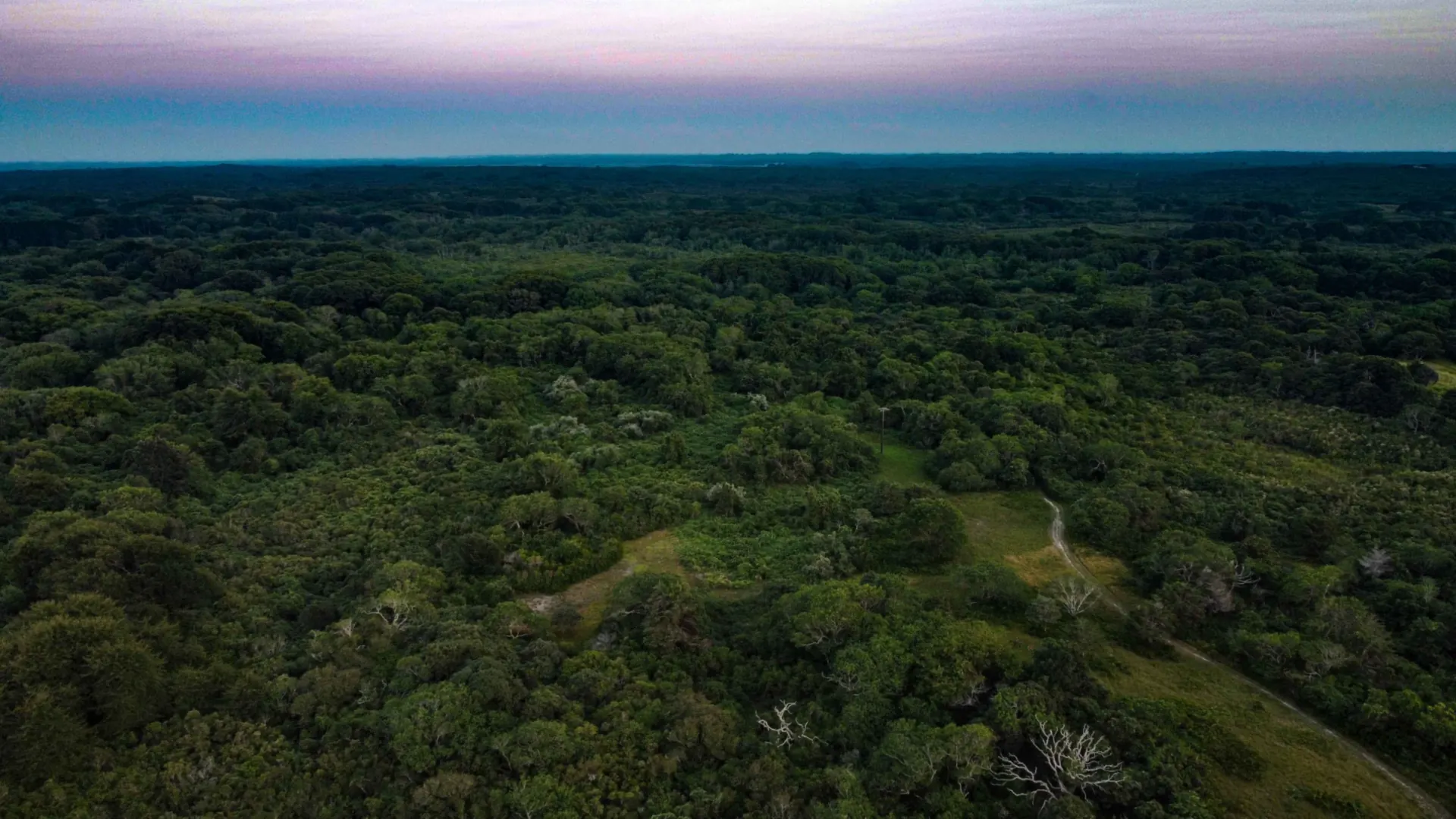
Everyone arrives for the water. The part of the island I would actually take you to on a clear afternoon has none in it.
Every visitor to Nantucket arrives with the same mental image, and it is almost always coastal: a beach, a harbor, a shingled house with a view of one or the other. Fair enough. That is what the island sells, and it is not false advertising.
But if you gave me a clear afternoon and told me to show you what living here is actually like, I would drive you inland.
The island nobody photographs
Get a few minutes off the Milestone Road and Nantucket stops looking like a postcard and starts looking like something older and stranger. Low, open country running to the horizon. Scrub and bayberry and bearberry, none of it taller than your shoulder. Ponds with nothing built on them. No trees to speak of, so the sky takes up two-thirds of everything you can see.
This is the moors, and there is a great deal of it. More than 40% of Nantucket is permanently protected open space — the Nantucket Conservation Foundation holds roughly 9,000 acres, with the Land Bank, the ’Sconset Trust, Mass Audubon, the Trustees and the town holding the rest. I have written about what that does to prices elsewhere.
The thing worth saying here is simpler. It is all open to you, all the time, and almost nobody is out there. In the second week of August, when there is a wait for everything on this island, you can walk the Middle Moors for an hour and pass almost no one.
It rewards a slower kind of attention
The moors do not perform. There is no vista that resolves, no moment where the trail opens onto the thing you came for. It is the same low country for miles, and either that empties your head out or it doesn’t.
For most people it takes about twenty minutes. You stop checking how far you have gone. The wind is doing the only talking. Somewhere behind you the island is at full capacity and none of it is audible.
Sanford Farm is the walk I send people on first — a long, gentle track out to the Ram Pasture and eventually the south shore, so you get the whole cross-section of the island in one go: heathland to dune to ocean, and you have earned the water by the time you reach it. Squam Swamp is the opposite. Enclosed, green, boardwalked, and a genuine surprise on an island most people assume is treeless.
It is worth knowing that none of this is wilderness, exactly. It is managed land, and the management is real work — mowing, brush cutting, and on some properties prescribed burns and organized deer hunts, all announced in advance. I mention it because people are occasionally startled to find a crew out there with equipment, and because it is a useful reminder that the openness is not an accident. Somebody is paying for it and somebody is out there maintaining it.
Go an hour before sunset
Late afternoon, an hour or so before the sun goes down. Not for the photograph, although you will take one.
It is that low light across open heathland does something you do not get at the beach, where the sun sets over water and the whole show is in the sky. Out here the light is in the ground. The bearberry goes copper. The entire surface of the island changes color at once and then keeps changing for forty minutes while you stand in it.
In October it is better. In November, with the scrub gone rust-red and the wind honest about the time of year, it is the best thing on this island and there is nobody to share it with.
What it means for where you would live
The practical part, briefly, and then I will leave it alone.
When people ask what a Nantucket address buys, the answer usually gets given in beach terms — how far to the sand, whether you can see the water. But a house in Polpis, or Tom Nevers, or out toward Madaket, is sitting against thousands of acres that will not be built on. Ever. That is not landscaped privacy, which any neighbor can undo with a permit. It is structural privacy. It changes what a morning looks like from the kitchen window, and it changes what happens to the street over thirty years.
It also changes what you do with a Sunday. A house near the moors comes with a few thousand acres of walking attached to it, at no cost and with no gate, which is a strange thing to find at this end of any market.
Buyers who fall for the harbor usually know they have fallen for it. The ones who fall for the interior tend to discover it a year in, on a Tuesday in the fall, and then never quite shake it.
If that sounds more like you than the harbor version does, say so early when you start looking. It genuinely changes which houses I would put in front of you.
Whenever you want to go and walk some of it, I am around. sean@thekalmanco.com.