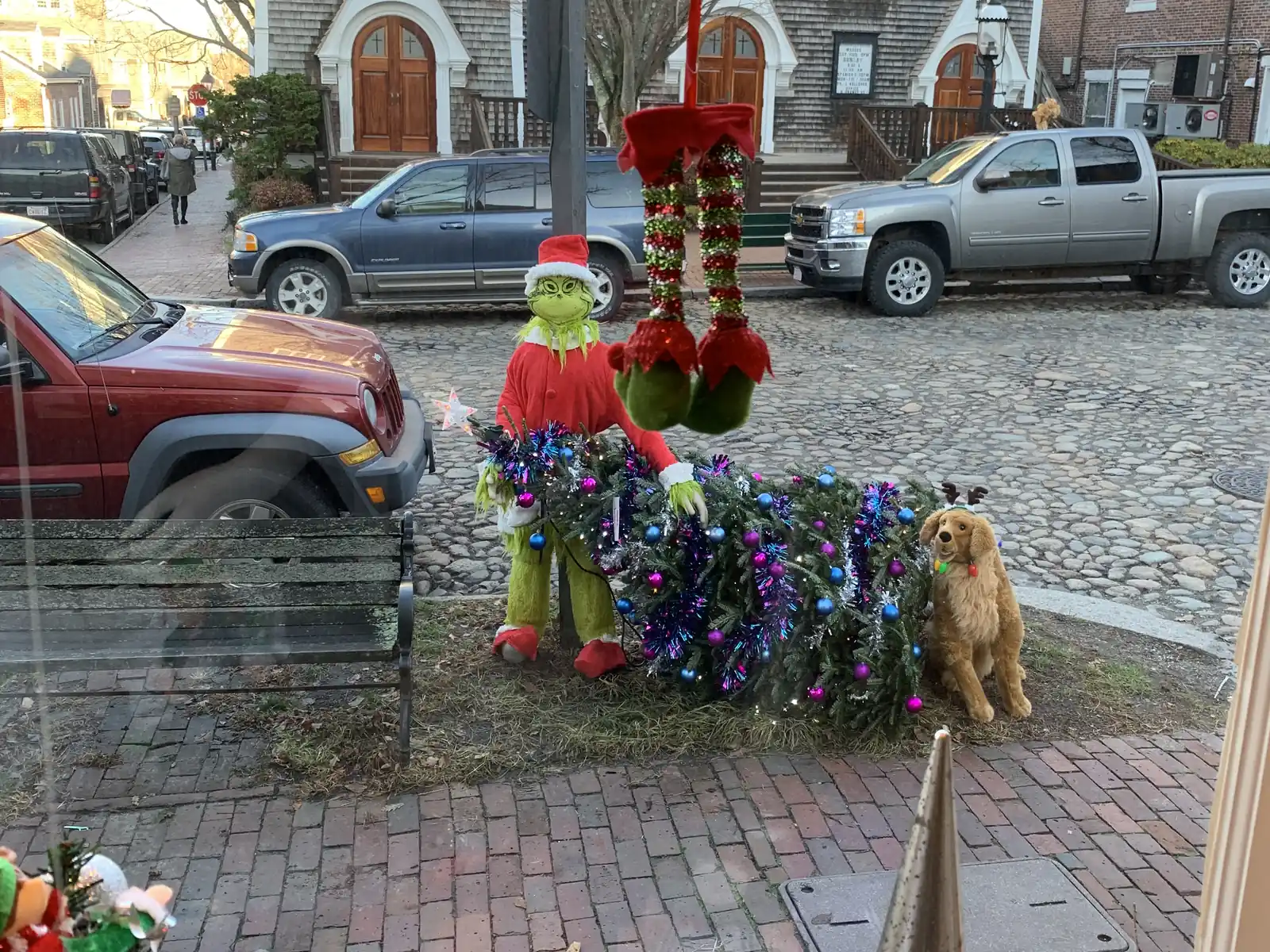
Main Street went bright on November 1st. The Stroll doesn’t arrive until December 4th. What happens in the weeks between the two never makes anyone’s itinerary, and it might be the stretch of the island I like best.
The town between its two best-known weeks
Nantucket Noel opened on November 1st, and its lights and events will run on Main Street through December 31. The 52nd Christmas Stroll is less than three weeks out, and by then Main Street will be doing what it does: carolers, Santa’s arrival by Coast Guard boat, the biggest crowd the island sees all winter. Right now, in the middle, there’s none of that. No Stroll crowds to dodge, no big weekend to plan around. Just the island, mostly to itself, for a little over two weeks.

It’s a strange gap to describe, because nothing is supposed to be happening in it. That’s exactly what makes it worth describing.
What’s actually happening out here right now
Open the island’s event calendar for this week and you’ll find a different corner of Nantucket getting a guided walk every morning: Coskata-Coatue on Monday, Polpis Harbor on Tuesday, then Smith’s Point, Smooth Hummocks, Norwood Farm, Beechwood Farm and Shawkemo Hills. None of it is for visitors. It’s the Nantucket Walkabout, a walking series that exists because enough people who live here year-round want to see the moors in November light, and someone organizes it without a press release.
Meanwhile the Atheneum’s weeknight rooms keep their own schedule — knitting group, philosophy club, open arts night — the same crowd that was there in August, minus everyone who only comes in August. Out on the harbor, the scallop boats keep working most mornings, because the season doesn’t care what the calendar says about holidays. And on Saturday, Sustainable Nantucket sets up its Pre-Thanksgiving market on Cambridge Street, with growers selling what’s actually in season now instead of what visitors expect to find.
None of this is dressed up for anyone. That’s the tell.
Why the houses feel different this time of year
Drive a street of mostly second homes in mid-November and you’ll notice the pattern before you can name it: dark windows, no cars, storm shutters already up on half the houses. Drive a street with more year-round owners and it reads the opposite way — porch lights on by five, a truck in the driveway, actual smoke from an actual chimney. Neither is better. They’re just different answers to the same question, and this time of year is when the honest answer shows up on the street itself instead of in a listing description.
It’s also the season that tests a house rather than photographs it. July shows you the view from the deck. Mid-November shows you whether the heat keeps up when the wind comes around to the northwest, whether the pipes were actually winterized last time, whether the driveway drifts shut before the plow gets there. None of that shows up in July pictures, and all of it shows up in how a house actually lives here once the crowd’s gone home.
What this lull actually tells a buyer
If you’re serious about a street, walk it now, not in August. The quiet weeks before the Stroll show you a neighborhood’s actual, year-round population — not the one that fills it for ten weeks of summer, but the one that’s there on a Tuesday in the middle of November with nothing scheduled and nowhere else to be. That’s the population you’d be joining if you bought in. Some streets have plenty of it. Some streets, honestly, don’t, and that’s worth knowing before you fall for a house in July and close on it having never once seen it in the off-season.
I spend a fair amount of this stretch just walking around — no open house to get to, no deadline, just looking at how the island holds itself together when nobody’s watching. It’s a useful habit, and not a bad one to borrow before you buy here.
If you’d like to walk a street together before you decide anything, I’m happy to make the time, this time of year especially. Email me any time at sean@thekalmanco.com.