Getting around Nantucket: do you need a car?
The short answer depends on where you sleep
If you are staying downtown or mid-island between June and September, you do not need a car. You will often be faster without one. If you are out at Madaket, Wauwinet, Tom Nevers or Quidnet — or you are here in February — a car stops being optional.
That is the whole answer. Everything below is the detail behind it.
What makes a car unnecessary in season is not the size of the island. It is that Nantucket has three transport systems stacked on top of each other: more than 35 miles of paved sidepaths, a shuttle network that is free to ride all through 2026, and a licensed taxi fleet running on Town-set flat rates. In winter, two of those three go quiet, and the calculation flips.
Getting here is a separate question
This page is about moving around once you have landed. The crossing itself — Steamship and Hy-Line out of Hyannis, Seastreak from New Bedford, the January car-reservation scramble, and which airlines serve ACK — is covered in full on getting to Nantucket. If you have not sorted the boat yet, start there and come back.
Two pieces of arrival belong here. Both ferry lines land you in the middle of Town, minutes on foot from Main Street. And if you are bringing a bicycle rather than a car, the Steamship carries it for $8.50 one-way and Hy-Line for the same, $17 round trip — which is, for a lot of summer visitors, the entire transport budget.
The bike paths are the island's best-kept transport story
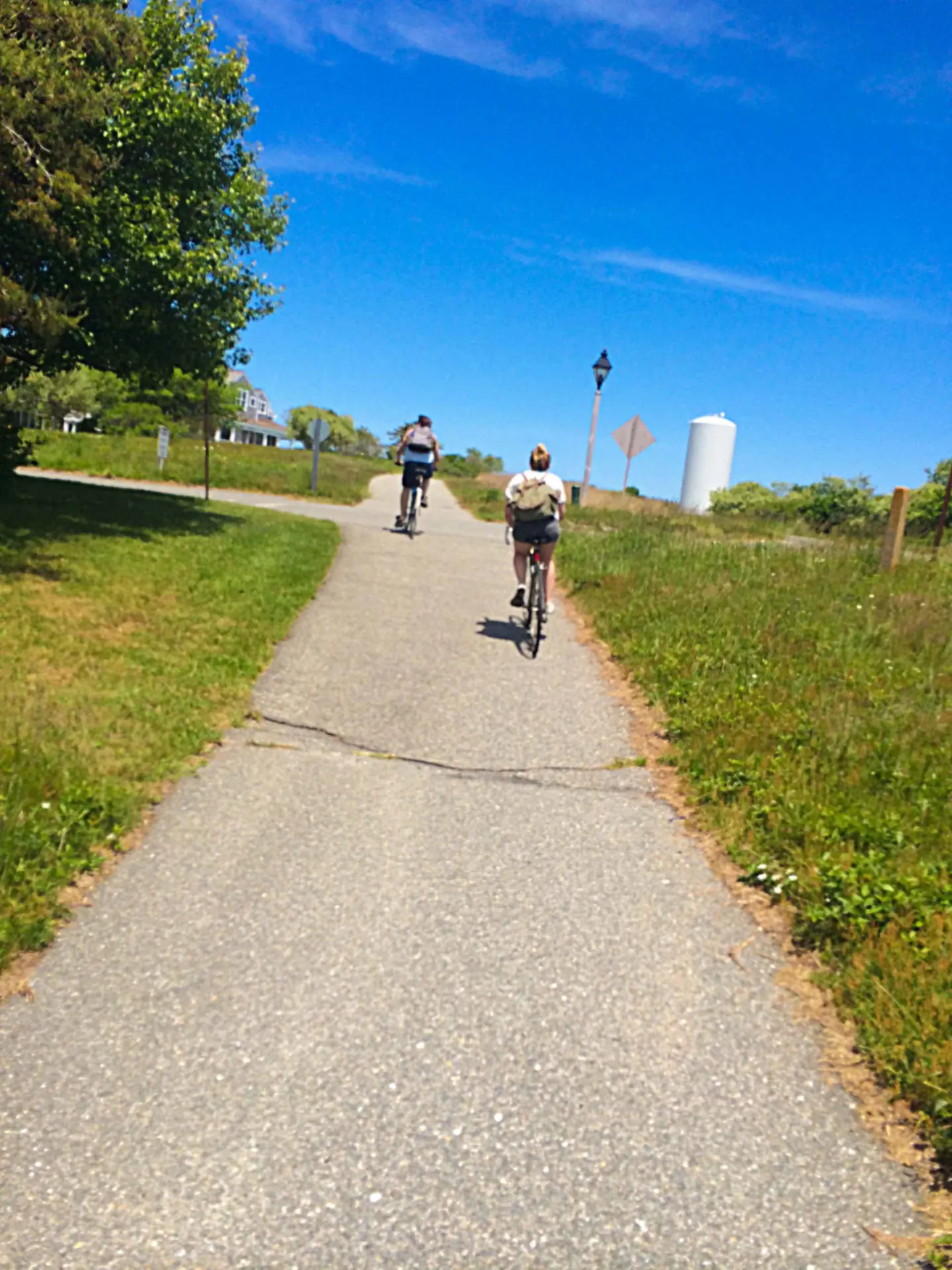
Nantucket has more than 35 miles of paved sidepaths, and they are the fastest way to move around the island in summer.
Locals call them bike paths; the Town calls them sidepaths, because they are shared — wide paved routes carrying cyclists, runners, walkers, strollers and wheelchairs alongside the road rather than on it. Seventeen are named on the Town's own map, and the long ones go where you actually want to go. The Town publishes the length of each, measured between its own endpoints:
Read those as path lengths, not as distances from Main Street — most start at a rotary or a school rather than in the middle of town, so add the ride out to the trailhead. On the two that matter most: the Sconset Path is a shade over half an hour from the Milestone Rotary at an easy ten miles an hour, and Madaket about thirty-five minutes from Caton Circle. The Polpis route to 'Sconset takes longer than the Milestone route because it is nearly three miles longer. People ride it anyway, because it is the better ride.
You also do not have to ride both directions. Every Wave shuttle bus carries two bikes on a front rack at no extra fare, so riding out and catching the bus home is a completely normal island move.
Two rules people get wrong. First, helmets: state law covers riders sixteen and under, but the Town's own bylaw requires a helmet for any rider over twelve — read together, essentially every cyclist on Nantucket is required to wear one, which is stricter than the Town's public-facing page suggests. Second, electric: Class 1 and Class 2 e-bikes are allowed on the paths, nothing capable of more than 20 mph is, the path speed limit is 20 mph, and double riding is prohibited. E-bike use has grown fast enough that Town leaders convened a safety summit in July 2026 after a run of serious crashes. If you are renting e-bikes for a family, that is worth two minutes of your attention.
The Wave: eleven routes, and free to ride in 2026
Taxis and rideshare, and their real limits
Nantucket taxis run on Town-set flat zone rates rather than meters, so you know the fare before you get in.
The published schedule puts airport to town at $23.00 for one passenger, town to 'Sconset at $35.00, town to Madaket at $31.00, and airport to Wauwinet at $42.00. Each additional passenger is $3.00, fares between 11:00 PM and 7:00 AM carry a $5.00 surcharge, and booking ahead from the ferry or airport adds a reservation fee. Those rates were adopted in May 2024 and remain the Town's current published schedule — check the Town's taxi page before you budget a week of them.
Uber and Lyft do operate here. The cleanest official confirmation is that the Town's 2026 airport rates charge "technology-enabled providers" $3.25 per originating fare at ACK.
What nobody will promise you is supply. This is an island with a finite number of drivers. On an August Saturday at boat time, or at one in the morning anywhere, the app can simply come back empty. Islanders keep a taxi number in their phone for precisely this reason, and you should too.
Parking in town, honestly
Downtown parking is governed by posted time limits and permits, and the binding rule is seasonal: in the Residential Parking District, a two-hour limit applies without a permit from June 1 to September 30, with no time restriction from October 1 to May 31.
The Town runs three parking districts — Core, Residential and Commercial — and publishes a districts map worth reading before you rely on a space. Its own guidance is that the downtown two-hour zones are enforced year-round, while enforcement generally eases between September 15 and June 15. Moving a few car lengths does not reset the clock; the bylaw requires at least fifty feet. Public lots include 2 Fairgrounds Road and the airport lot, and the Town publishes no on-street meter rates — the system is time limits and permits, not coins. Residents can buy permits through the Police Department, currently $50 for each of the first two per address if bought by May 31 (fees are reset periodically, so check before you budget).
The honest picture is simpler than the bylaw. From late June through August, kerbside parking in the core is genuinely hard, and circling for it costs more time than the walk you were avoiding. From November to April it is a non-issue. This is also why off-street parking downtown is a real asset rather than a nicety: a deeded space or private driveway shows up again at resale, and it is one of the details that separates two otherwise similar in-town houses.
Mopeds and scooters
Mopeds are legal on Nantucket's roads and barred from its bike paths — and that comes from two directions at once, state law and Town code.
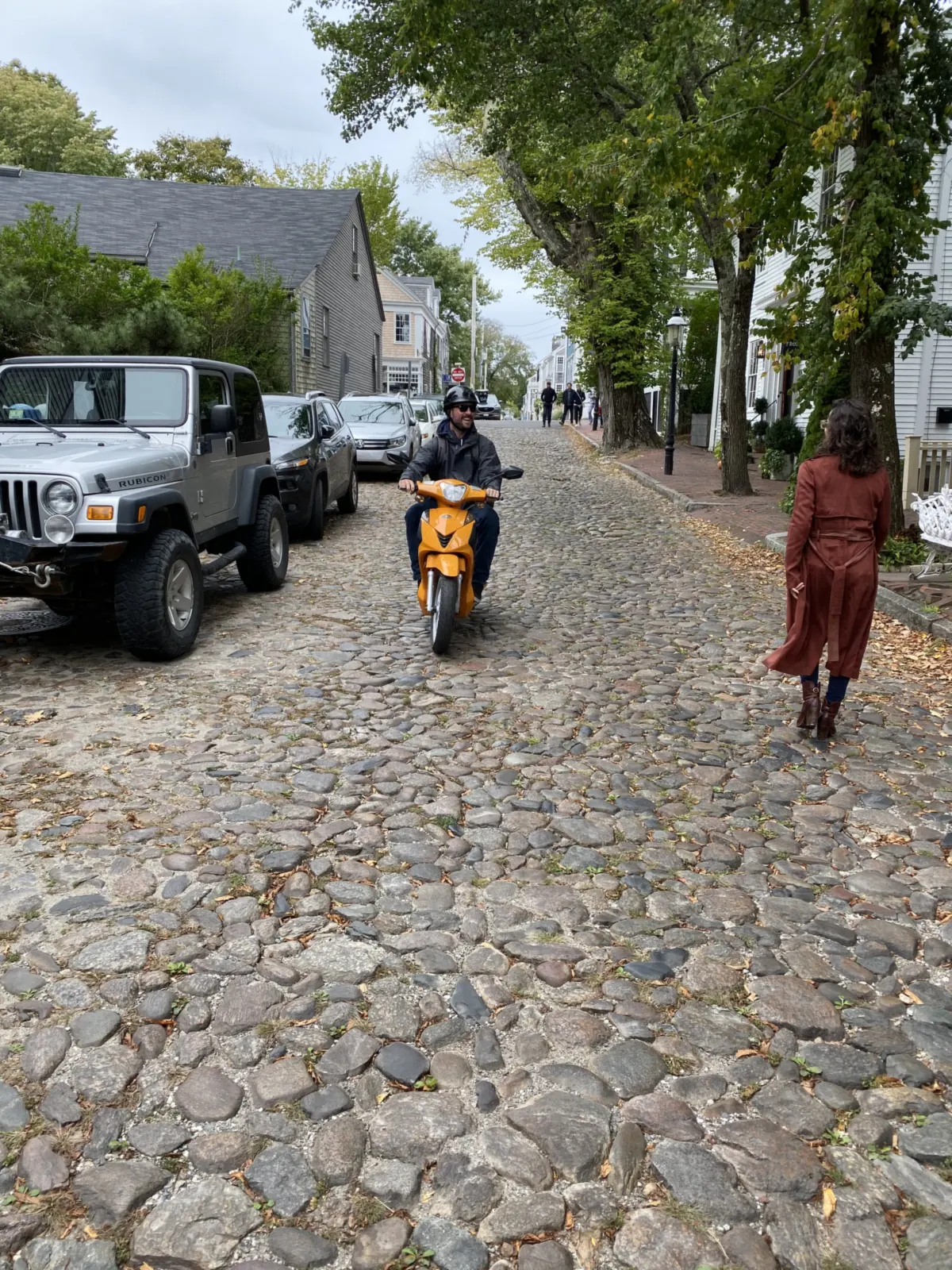
Massachusetts law allows a motorized bicycle in bicycle lanes alongside a road but excludes it from off-street recreational bicycle paths. The operator must be at least sixteen, hold a valid driver's license or learner's permit, wear approved headgear, and stay under twenty-five miles an hour. Nantucket's own code closes the question from its side by defining a bicycle path as a way on which motorized vehicles of any kind are excluded. Motorized scooters and Segways go further still: Town code bars them from any Town way, sidewalk, park, playground or beach without express written permission.
The local friction is not folklore, it is written into the bylaw. Nantucket's moped rental article exists, in the Town's own words, to prevent serious injuries "as has happened in the past on Nantucket Island" from the unregulated rental of these machines. Rental agencies need an annual licence from the Select Board, carry a $2,500 licence fee, must issue a helmet with every machine, must keep a register of rentals including a record of every accident, and must hand each renter a map of the island. Before June 1 each year the Chief of Police designates a Moped Enforcement Officer, paid for by a surcharge on the rental companies.
That is a town that has thought hard about mopeds. Narrow roads, sand at the edges, blind corners out Polpis and Madaket, and a summer full of drivers who do not know where they are going make a poor combination with an unfamiliar two-wheeler. You will see mopeds every summer, and you will hear what year-round residents think of them. If you want two wheels here, a bicycle is the better answer in almost every case.
The airport run
Nantucket Memorial Airport is served by the Wave's year-round Airport route, by taxi at a published flat rate, and by three rental counters in the terminal — Hertz, Nantucket Island Rent-a-Car and Nantucket Windmill Auto.
For an early flight, book a taxi the night before rather than trusting an app at six in the morning. And know that ACK is close to everything: the drive times published on this site's district pages put it at roughly eight minutes from mid-island, ten from Tom Nevers, eleven from 'Sconset, fourteen from Surfside and twenty-six from Madaket. The airport sits nearer the middle of the island than town does, which is why so many districts are quicker to a plane than to a pint of milk.
What changes after Columbus Day
Most of the shuttle network stops. Surfside and 'Sconset via Polpis end in mid-September, 'Sconset via Milestone around the twentieth, Jetties in early October, Madaket in mid-October. What survives the winter is Mid Island, the Fast Ferry loop and the Airport route.
This is the most important paragraph on this page for anyone thinking about living here rather than visiting. A carless summer on Nantucket is a lifestyle choice. A carless January is a genuine constraint: the beach routes are gone, daylight is short, and the weather is Atlantic. The Town publishes no seasonal closure for the sidepaths, but weather does its own enforcing — they are not how you get to the grocery store in a northeaster.
Every year-round resident I know keeps a car. Most keep an old one they are not precious about, because salt air is undefeated. If you are weighing the move, living on Nantucket and the off-season island go deeper into what the other forty-two weeks ask of you.
Bring a car, rent one here, or go without
Three options, and the right one depends almost entirely on how long you are staying.
One footnote for the four-wheel-drive contingent. Driving on the Town's beaches — 40th Pole, Eel Point, Nobadeer, Smith's Point and the rest — requires an annual beach vehicle permit from the Nantucket Police Department, and it does not cover Great Point, which sits under a separate permit that is not the Town's. Permits run the calendar year, the vehicle has to be genuine four-wheel drive carrying a shovel, jack and full-size spare, and access is restricted through the summer nesting season. It is a real part of island life and a real line in the diligence for anyone buying with beach access in mind.
Getting around, district by district
Where you buy determines how you move. This is the part buyers underweight and owners learn in a season.
Drive times below are the figures published on this site's district guides, computed from live routing data. Treat them as good-conditions estimates and add real minutes for August traffic.
Between the poles sit the rest: Polpis at eleven minutes, Miacomet at nine, Surfside at eleven with a summer shuttle and a 2.2-mile path, Cisco at fourteen, Quidnet at seventeen and genuinely remote. The pattern holds: the closer to town and the closer to a path, the less the car matters — and the more you pay per square foot for that convenience.
If you are early in the search, every neighborhood guide lists drive times for exactly this reason, and the buyer's guide covers the rest of the decision. Once you are here, the beaches guide tells you which one is worth the ride.
Getting around Nantucket — frequently asked questions
Do you need a car on Nantucket?
No, not in summer, and not if you are staying downtown or mid-island. The island has a free 2026 shuttle network, more than 35 miles of paved bike paths reaching the major beaches and villages, and licensed taxis on Town-set flat rates. You do need one if you are staying at Madaket, Wauwinet, Tom Nevers or Quidnet, or if you are here outside the summer season, when most shuttle routes stop.How do you get around Nantucket without a car?
Four ways, in order of usefulness: the NRTA Wave shuttle, free to ride for all of 2026; a bicycle on the island's 35-plus miles of paved sidepaths; walking, since Town itself is entirely walkable; and taxis at published Town flat rates. Uber and Lyft operate but supply thins at peak times.Is there public transportation on Nantucket?
Yes. The Nantucket Regional Transit Authority runs the "Wave," eleven named routes covering the beaches, the villages, mid-island and the airport. Three — Mid Island, Fast Ferry and Airport — run year-round; the rest are seasonal. The downtown hub is the Greenhound Building at 10 Washington Street.How much does the Nantucket shuttle cost?
Nothing in 2026. Every Wave route is free to ride for the entire year, funded by MassDOT, and the Town of Nantucket confirms all riders ride free through 2026.How long are the Nantucket bike paths?
More than 35 miles of paved sidepaths across 17 named routes. The longest are the Polpis Road Path at 8.7 miles and the Sconset Path at 6 miles; the Madaket Road Path runs 5.7 miles, the Cisco Path 3.1 and the Surfside Road Path 2.2.Can you bike to 'Sconset from Nantucket town?
Yes, by either of two paths. The Sconset Path runs 6 miles along Milestone Road from the Milestone Rotary to the 'Sconset Rotary; the Polpis Road Path takes a longer, prettier 8.7-mile route past Altar Rock and Windswept Cranberry Bog. Reckon on a little over half an hour on the Milestone run at an easy pace, plus the ride out to the rotary.Does Uber work on Nantucket?
Yes. Uber and Lyft operate on the island — the Town's 2026 airport rates charge technology-enabled providers $3.25 per originating fare at ACK. Availability is the real limit: on a peak-season evening or late at night the app may show nothing, so keep a taxi number as a backup.How much is a taxi from Nantucket airport to town?
$23.00 for one passenger under the Town's published flat-rate zone schedule, plus $3.00 for each additional passenger. Town to 'Sconset is $35.00 and town to Madaket $31.00. Fares between 11:00 PM and 7:00 AM carry a $5.00 surcharge. These are the rates adopted in May 2024 and still published by the Town.Is parking free in downtown Nantucket?
The Town publishes no on-street meter rates — downtown parking is governed by posted time limits and permits rather than coins. In the Residential Parking District a two-hour limit applies without a permit from June 1 to September 30, with no time restriction from October 1 to May 31. Moving your car must be at least fifty feet to reset the clock.Can you ride a moped on the Nantucket bike paths?
No. Massachusetts law excludes motorized bicycles from off-street recreational bike paths, and Nantucket's own code defines a bicycle path as a way on which motorized vehicles of any kind are excluded. Mopeds are legal on the roads: riders must be at least sixteen, hold a valid driver's license or learner's permit, wear approved headgear, and stay under 25 mph.Should I bring my car on the ferry or rent one on Nantucket?
For a summer stay under a week in town or mid-island, neither — the free shuttle and a bike will cover it. For longer, or for a house the shuttle does not reach, renting on island is usually simpler: three companies have counters in the airport terminal, and it avoids the January ferry-reservation scramble entirely. Bring your own when you are coming for a month or moving in.How do you get around Nantucket in the winter?
By car, mostly. The Mid Island, Fast Ferry and Airport shuttle routes run year-round, but the beach and village routes stop between mid-September and mid-October. The sidepaths have no published seasonal closure, but they stop being practical transport in Atlantic weather. Nearly every year-round resident keeps a car here.Trying to work out whether a house works without a car?
Sean Kalman is a sixth-generation Nantucketer, a Nantucket REALTOR®, and the founder of The Kalman Co., brokered by eXp Realty. He has been getting around this island by bike, boat and beaten-up island car his whole life. Reach him at sean@thekalmanco.com or 508-228-4578. Equal Housing Opportunity.