THE KALMAN Co.
ListingsKnow NantucketAbout
Contact Sean
The reference · Vocabulary

Nantucket real estate, translated

By Sean Kalman — The Kalman Co., brokered by eXp Realty. Buyers arrive fluent in inspections and escrow, then hit ground cover ratio, a 2% fee nobody budgeted for, and a septic permit that quietly decides how many bedrooms their house legally has.

A vocabulary, not just jargon

Every market has jargon. Nantucket has a vocabulary — words that mean something specific here and nothing at all on the mainland, and that turn up in the first ten minutes of the first showing.

None of it is difficult. It is just local. Here is the language, grouped the way it actually comes at you, with the full explanation a click away wherever one exists.
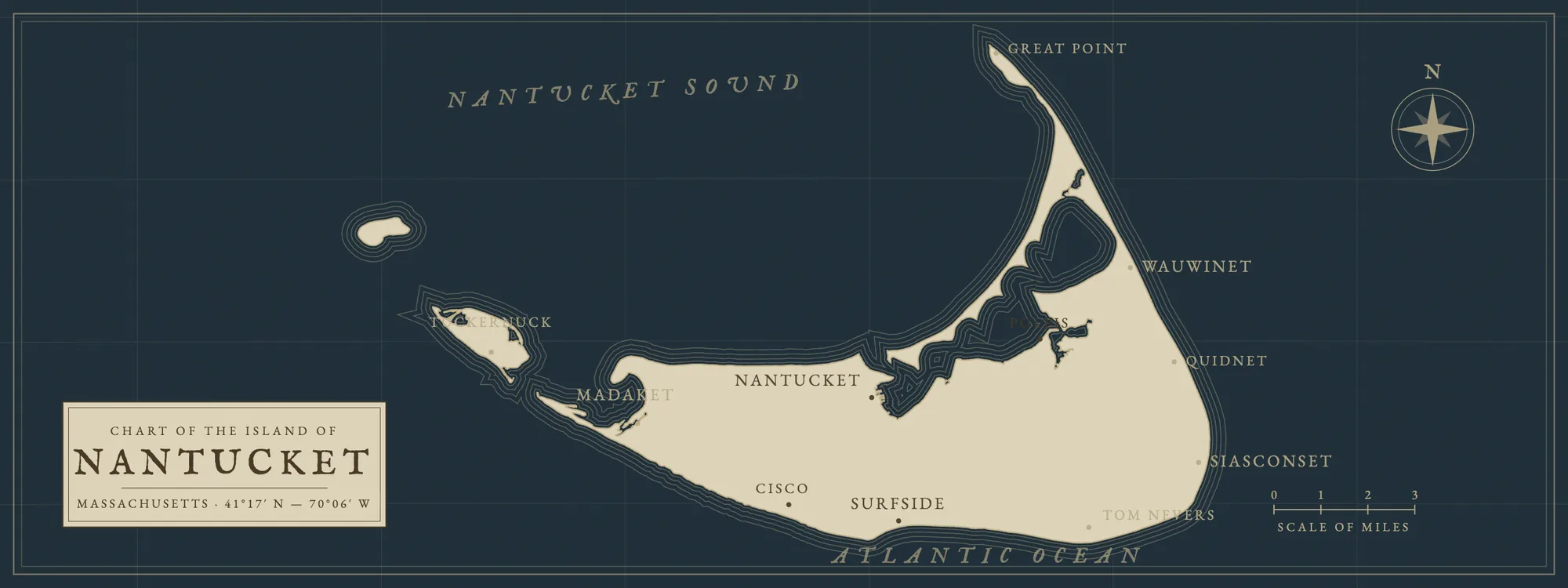
Vintage nautical chart of Nantucket — the island's real estate runs on its own map and its own vocabulary

The rules that decide what you can build

Four separate authorities can say no to the same project, each on its own timeline. Knowing which one you are talking to is most of the battle.

Historic District Commission (HDC). The HDC reviews exterior work on Nantucket — and "Nantucket" means the entire island, plus Tuckernuck and Muskeget, roughly 30,000 acres, under a 1970 special act of the Legislature. This is not a downtown-only rule, and it catches people. Paint color, windows, roofing, fences, driveways, equipment placement, demolition: all of it needs approval before a building permit issues. Interiors are yours alone. The town core and the Sconset village core draw the strictest review. Budget real time for it — here is how the process actually runs.
Certificate of Appropriateness. The HDC's approval document, and the thing that gates your building permit. It certifies that a specific set of exterior drawings meets the Commission's standards, and it stays valid for three years from issuance. Note what it does not do: a Certificate of Appropriateness says nothing about zoning relief, Conservation Commission jurisdiction, or septic capacity, each of which is a separate approval you still have to win. Sellers should keep copies. Buyers planning changes should ask what has already been approved.
Ground cover ratio. The single number that decides how much house a lot can hold. The zoning bylaw defines it as the ground cover upon a lot divided by the area of the lot, expressed as a percentage — footprint over lot size. Allowable ratios vary sharply by zoning district, from 75% in Commercial Downtown down to 0.5% in the Moorlands, so two half-acre lots a mile apart can support very different houses. Nantucket layers on a "regularity factor" as well, which penalizes long, skinny lots. Ask for both numbers before you fall in love with the land — the zoning guide runs the full table.
Secondary and tertiary dwelling. Island shorthand for legal additional houses on one lot. A secondary dwelling is a detached single-family unit sharing a lot with the primary house; the bylaw requires its footprint to differ from the main house by at least 20%, sets a minimum ten-foot separation, and permits connection only by a breezeway. A tertiary dwelling is a third unit — a garage apartment or a small detached building — generally capped at 900 square feet. Both are bounded by district density and bedroom limits, and some tertiary units carry a year-round occupancy restriction. They change what a property is worth.
Covenant lot. A lot or dwelling carrying a recorded restriction limiting who may occupy it, most often to a year-round Nantucket household, granted in exchange for density or price concessions. The Nantucket Housing Needs Covenant is the best-known version. The restriction runs with the land and survives the sale, so it binds the buyer personally. If a listing looks priced unusually against its neighbors, read the deed before anything else.
Title 5. The Massachusetts septic code, 310 CMR 15.000 — and the reason "how many bedrooms" is a legal question here, not a decorating one. A system must be inspected at or within two years before transfer, or three with annual pumping records, and permitted capacity is measured in bedrooms at 110 gallons per day each. A house marketed with five bedrooms over a three-bedroom permit is a problem the buyer inherits. Several Nantucket watershed districts also require nitrogen-reducing systems, sometimes triggered by the sale itself. What to check, and when.

Where the money actually goes

Two of these line items routinely surprise off-island buyers. The third is the number people trust that they shouldn't.
Land Bank fee. Nantucket charges a 2% transfer fee on most purchases, and — this is the part that lands hardest — the buyer pays it. It is not a negotiating point. The 1983 statute creating the Land Bank makes the purchaser liable and states plainly that any agreement allocating it to someone else does not affect that liability. On a $3,000,000 purchase, that is $60,000 due at closing, and the registry will not record your deed without a Land Bank certificate. Qualifying first-time buyers get a partial exemption on the first slice of the price — the Land Bank Commission resets that amount every January, so treat any figure you read anywhere as stale until confirmed. The full mechanism, exemptions and all.
Assessed value versus market price. The Town's assessed value is an input to a tax bill, not an opinion of price. Assessments run on a schedule and lean on sales data already a year or more old by the time the bill arrives. On an island where land carries most of the value — and land is the hardest component to assess precisely — the gap widens further, and Nantucket homes have recently been closing well above assessment. An assessment is not a ceiling, not a floor, and not a bargaining chip. Why the two numbers diverge.
Short-term rental registration. Renting by the week is legal and ordinary here, but it is a registered activity. Operators need a Short-Term Rental Certificate of Registration from the Nantucket Board of Health, renewed annually, plus a Massachusetts Department of Revenue registration — the state number comes first, because you need it to register locally. A Special Town Meeting in November 2025 settled years of uncertainty by permitting short-term rentals as an allowed use in every zoning district except Commercial Industrial. Where the rules stand now.

Land, water, and what the ocean decides

Nearly half of Nantucket will never be built on, and a good deal of what has been built sits somewhere on a spectrum of coastal risk. These are the terms that describe both.

Flood zone. FEMA sorts coastal property into mapped zones, and on Nantucket the difference between two of them is real money. Zone AE is land with at least a 1% annual chance of flooding where wave heights stay below three feet. Zone VE — the Coastal High Hazard Area — is where waves reach three feet or more, and it carries genuinely stricter construction requirements: open pile foundations, breakaway walls below the lowest structural member, no building on fill. Zone X sits outside the mapped high-risk area. Zones, premiums, and what to ask.
Elevation certificate. A surveyed document recording where a building sits relative to the Base Flood Elevation — the height a 1%-annual-chance flood is expected to reach. Under FEMA's Risk Rating 2.0 pricing you no longer need one to buy a flood policy, because FEMA estimates first-floor height on its own. It still earns its cost twice over: a surveyor's actual measurement can beat FEMA's estimate and lower your premium, and local floodplain permitting still asks for it. Get one before you renovate, not after.
Coastal bank and setback. A coastal bank is a protected resource area, and building anywhere near one runs through the Conservation Commission under both the Massachusetts Wetlands Protection Act and Nantucket's own wetlands bylaw, which is stricter than the state's. Buffer zones extend inland from the resource area. On an actively eroding shoreline, the binding constraint is not only where the setback falls today but where the bank will be in twenty years. How erosion is reshaping the shoreline.
Conservation restriction. A recorded, usually permanent limit on what may be done with a parcel, held by a conservation organization or a government body under Massachusetts General Laws chapter 184, sections 31 to 33. It is a real property interest: it runs with the land, survives every sale, and cannot be waived by a seller or negotiated away at closing. Restrictions vary enormously — some bar all construction, others define a building envelope or allow a replacement dwelling — so read the recorded instrument itself rather than a summary. Releasing one takes a public hearing and state approval, which in practice means it does not happen.
The Land Bank, the Conservation Foundation, and the Trustees. People use these three interchangeably. They are not the same thing. The Nantucket Islands Land Bank is a public agency with an elected commission, funded entirely by the 2% transfer fee, that buys land for conservation, recreation and agriculture. The Nantucket Conservation Foundation is a private nonprofit founded in 1963 that owns roughly 9,000 acres — close to a third of the island — including the Middle Moors. The Trustees of Reservations is a statewide nonprofit whose Nantucket holding is the Coskata-Coatue Wildlife Refuge. Between them and others, nearly half the island is permanently protected. Who owns what, and why it shapes prices.

The shorthand you'll hear on a showing

None of this is written down anywhere. It is simply how people here talk about houses.

LINK. Nantucket has its own multiple listing service, and it is not the mainland MLS. LINK is the island's listing database, the one every Nantucket brokerage works from — which is why a house can be actively listed here and invisible on a national portal, or shown there with a stale price and a wrong status. If you are searching from off-island, that gap is the single biggest reason your picture of the market is off. Our listings run on a direct LINK feed.
In town, mid-island, 'Sconset. The island's everyday geography. "In town" is the historic core — cobblestones, wharves, walk to everything. "Mid-island" is the year-round working heart of Nantucket: schools, services, and the island's most attainable prices. "'Sconset," never said as Siasconset in conversation, is the village seven miles east on the bluff, with its own beach, post office and rhythm. Everything else tends to get named for its road or its beach. All thirty-two areas, mapped.
Antique, or pre-1850. On Nantucket the dividing line is real, and it is an accident of economics. The Great Fire of 1846 destroyed roughly a third of the town, whaling was already collapsing, and the 1849 gold rush pulled the young men west — so the island effectively stopped building for decades. What survived simply stayed. That is why the town reads as a single coherent period and why a pre-1850 house gets described that way in a listing. What owning an antique house involves.
Upside-down house. A house with the living space upstairs and the bedrooms below. It sounds like a mistake and it is a deliberate local convention: where a lot has a water view, the view exists only from the upper floor, so kitchen, dining and living go up and the bedrooms — which you mostly use in the dark — go down. Common in newer construction and in renovations near the water. Worth knowing before you walk in and wonder what happened.
Roofwalk. The railed platform on the ridge of a roof. "Widow's walk" is the romantic name and, according to the Nantucket Historical Association, a myth — no captain's wife stood up there scanning the horizon for a sail. Roofwalks were fire equipment. Chimney sparks landing on wood shingles were a constant hazard, and the walk gave a homeowner fast access from the attic to the roof with a bucket of sand. They were also excellent for watching the harbor. Locals say roofwalk.
Off-season and shoulder season. Summer is the market's engine, but the island runs in four gears. High season is roughly late June through Labor Day. The shoulder seasons — May into June, September into October — are when many islanders think Nantucket is at its best, and when the more serious buyers tend to appear. The off-season, roughly November through April, is quiet and thin on inventory, and often the most productive stretch of the year to negotiate. What the off-season is actually like.

The island vocabulary — frequently asked questions

Who pays the Nantucket Land Bank fee, the buyer or the seller?

The buyer. Nantucket's 2% transfer fee is statutorily the purchaser's liability, and the 1983 act creating the Land Bank specifically says a private agreement shifting it to the seller does not change that. It is due at closing, and the registry of deeds will not record the deed without a Land Bank certificate. Budget it in cash alongside your down payment.

Why is a Nantucket home's assessed value so different from its sale price?

Because the assessment exists to apportion a tax levy, not to price a house. Assessments follow a schedule and rely on sales data already a year or more old, and on Nantucket most of a property's value sits in the land — the hardest component to assess precisely. Recent island sales have closed well above assessed value. Price from recent comparable closings instead.

What is ground cover ratio, and why does it matter more than lot size?

Ground cover ratio is a building's footprint divided by the lot area, expressed as a percentage, and the zoning bylaw caps it by district — from 75% in Commercial Downtown down to 0.5% in the Moorlands. It, not acreage, is what determines how much house a lot can legally hold — so two similarly sized lots in different districts can support very different homes. Confirm the applicable ratio before you make an offer on land.

Does the Historic District Commission really review every house on Nantucket?

Every exterior change, yes. The HDC's jurisdiction covers the entire island plus Tuckernuck and Muskeget under a 1970 special act, so this is not limited to downtown. Roofing, windows, paint color, fences, driveways, equipment and demolition all require a Certificate of Appropriateness before a building permit issues. Interior work falls outside its authority.

What's the difference between the Land Bank, the Conservation Foundation, and the Trustees?

The Land Bank is a public agency with an elected commission, funded by the 2% transfer fee, that buys land for conservation and recreation. The Nantucket Conservation Foundation is a private nonprofit, founded in 1963, that owns close to a third of the island. The Trustees of Reservations is a statewide nonprofit holding the Coskata-Coatue Wildlife Refuge. Three organizations, three very different roles.

What does a "three-bedroom septic" mean if the house has five bedrooms?

Under Title 5, septic capacity is permitted in bedrooms at 110 gallons per day each, and the permit — not the floor plan — sets the legal bedroom count. A five-bedroom listing on a three-bedroom permit is either an upgrade you will pay for or a marketing claim that cannot be legally supported. Confirm the permit before you offer.

Fluent in the island's terms — and in what they cost you

Every term on this page shows up in a real transaction eventually. Sean will tell you which ones apply to the property you're actually looking at.
Start the conversation Call 508-228-4578
About the author

Sean Kalman is a sixth-generation Nantucketer, a Nantucket REALTOR®, and the founder of The Kalman Co., brokered by eXp Realty. He grew up speaking this vocabulary, which is exactly why he remembers to translate it. Reach him at sean@thekalmanco.com or 508-228-4578. Definitions reflect Nantucket and Massachusetts rules as of August 2026; specifics change at Town Meeting and in Boston, so confirm current requirements before relying on them. Equal Housing Opportunity.

Explore
HomeListingsNeighborhood Guides
Insights
Know NantucketTalking NantucketMarket Report
Guides
Buying GuideSelling GuideHome ValuationAll Island Guides
Company
About & TeamContact
THE KALMAN Co.
InstagramFacebookLinkedIn
Nantucket, MA 02554 · 508-228-4578 · sean@thekalmanco.com · Brokered by eXp Realty