Nantucket in the winter: what the island is like from December to March
A year-round town with the summer layer taken off
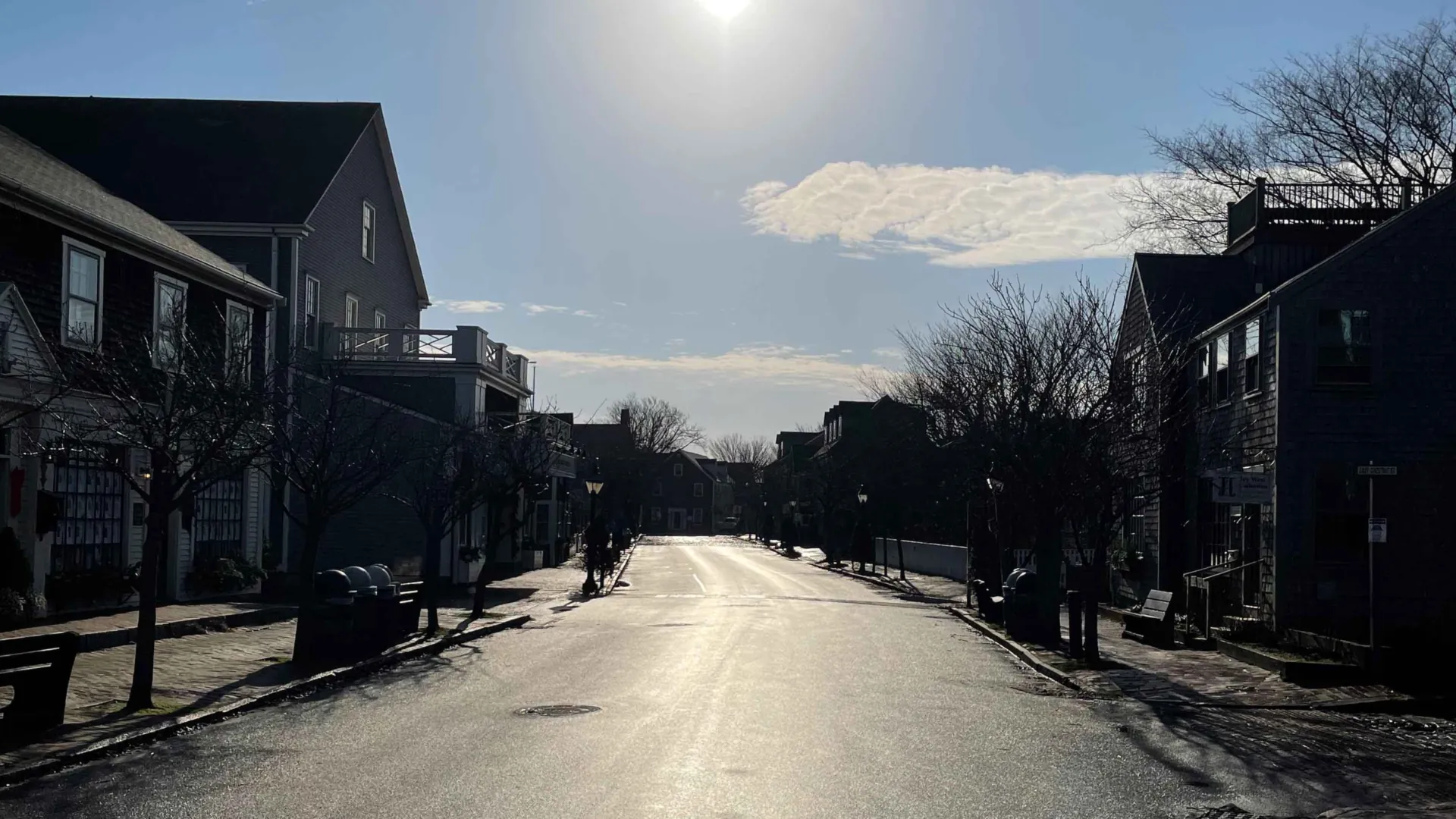
Winter on Nantucket is not the island closed. It is a small New England town, thirty miles out to sea, going about its year with the summer layer taken off. The grocery stores, the hardware store, the pharmacies, the hospital, the library and the schools all run. Both ferry lines run. What changes is the scale: fewer places open, shorter days, and weather that gets a vote in your plans.
This page is about winter itself, December through March: what the season looks like, how to get here and get around, what stays open, where to walk, and what the cold months show you about a house. The off-season guide covers the whole quiet half of the year, October to April, including how owners run a house through it, and Nantucket in December is a portrait of the one month.
Winter arrives in three parts
December is the lit part. Nantucket Noel, the Chamber of Commerce's holiday program, runs on Main Street from November 1 through December 31 in 2026. It builds to the 52nd Christmas Stroll on December 4–6: the town dressed for the season, shops open late, carolers on the cobblestones, Santa arriving by Coast Guard boat, and the biggest crowd the island sees all winter. How Main Street builds its winter season has the detail.
January through March is the deep quiet. The count of open dining rooms contracts sharply after the holidays. The days are short, with sunset around 4:20 on a January afternoon, and the island belongs to the people who live on it. Out on the harbor it is scallop season: family permits open it in October, the commercial fleet follows in November, and the bay scallop is the island's winter signature.
Then the turn. Kitchens and shops rebuild toward Daffodil Weekend in late April, when the island wakes up in earnest. If you only know Nantucket in July, any of the three will show you a different place.
Getting here in winter: both ferry lines run, and the wind gets a vote
Weather is the real schedule. High wind cancels a handful of crossings each winter. The fast boats stand down first and the traditional ferry is the last to stop, so people here build a spare day into winter travel and check the operators' status pages before driving to Hyannis. One thing is easier: a car reservation, contested from the first morning for summer dates, is far simpler to book in the off-season and costs less. Getting to Nantucket has the fares and the full picture.
Getting around: in winter, plan on a car
In summer, three systems make a car optional: the bike paths, the shuttle and the taxis. In winter two of the three go quiet. The Wave shuttle keeps three routes all year, Mid Island, the downtown Fast Ferry loop and the Airport route, and the beach and village routes stop between mid-September and mid-October. The paths stay open, and Atlantic weather decides how useful they are.
So bring a car on the traditional ferry or rent one here; three rental companies have counters inside the airport terminal. Taxis meet the boats and flights and run on flat rates set by the Town. Town itself is walkable in any month, and both ferries land a few minutes on foot from Main Street. 'Sconset, a walking village in July, is a genuine drive in February. Getting around Nantucket goes district by district.
What stays open, and where winter life happens
Everything a town needs stays open: groceries, hardware, pharmacies, coffee, Nantucket Cottage Hospital, the Atheneum with its full library program, and the Dreamland's winter film screen. Restaurants run on a winter rotation. A year-round core keeps serving, mostly downtown and mid-island, and the full roster does not return until spring, so call ahead between January and March. How Nantucket eats follows the dining year.
The Whaling Museum on Broad Street, home to a 46-foot sperm whale skeleton and a restored 1847 candle factory, posts its hours by season. Check them with the Nantucket Historical Association before you plan a day around it.
The geography of winter is smaller than summer's. Most of it plays out between the core of Town and the working shops of Mid-Island, which is also the only residential district with year-round shuttle service. 'Sconset keeps a quieter version going at the east end. Living on Nantucket is the long guide to the year-round island.
Outside in winter: empty beaches, open moors and the seals at Great Point
More than 40 percent of the island is permanently protected open space, and winter is when you have it nearly to yourself. The Nantucket Conservation Foundation's properties are open from sunrise to sunset and are used year-round. Walking the moors and the conservation land guide cover where that land is, and the beaches guide sorts the shoreline. One caution for the cold months: hunting is allowed in season on many conservation properties, and the Trustees of Reservations' advice is to wear bright colors.
If you make one winter outing, make it Great Point. The refuge is free to enter on foot in every season, and in the off-season walkers can park at the Wauwinet Gatehouse. Dogs, barred from April 1 to September 15, are allowed again from September 16 through March 31, on a leash. Gray and harbor seals haul out on the beach near the point, and the rule is to stay at least 150 feet away. Drivers still need the Trustees' oversand permit, which is required year-round.
What winter shows you about a house
I show property all winter, and the season does some of the work. You hear the heating system run and feel which rooms hold their warmth. You see how much light the house gets when the sun is low and gone by late afternoon. You learn what the wind does to that exposure, and whether the street has lights on in the evening or sits dark until June. None of that shows in a July photograph.
If you are thinking about owning here, the practical reading starts with running a house through an island winter, then heating and energy and caretaking. And if you can come only once before you decide, come now.
Questions people ask about Nantucket in the winter
What is Nantucket like in the winter?
Quiet, and fully a town. The island keeps its grocery stores, hardware store, pharmacies, hospital, library and schools running all year, and both ferry lines run from Hyannis. What changes is the scale: fewer restaurants and shops are open, the days are short, and wind sometimes cancels a boat. December is the liveliest winter month, with the Christmas Stroll on its first weekend.What is open on Nantucket in the winter?
Everything a town needs: groceries, hardware, pharmacies, the hospital, the library and the Dreamland's film screen. A year-round core of restaurants keeps serving, mostly downtown and mid-island. The count of open dining rooms contracts sharply after the holidays and rebuilds toward Daffodil Weekend in late April, so call ahead between January and March.Do the ferries to Nantucket run in the winter?
Yes. Hy-Line Cruises has run its high-speed ferry from Hyannis year-round since December 1995, and the Steamship Authority's traditional ferry, the only boat that carries cars, runs all year. High wind cancels a handful of crossings each winter, the fast boats first, so keep a spare day in your plans and check the operators' status pages.Do you need a car on Nantucket in the winter?
For most stays, yes. Three shuttle routes run year-round, Mid Island, the downtown Fast Ferry loop and the Airport route, and the beach and village routes stop between mid-September and mid-October. Town is walkable and taxis meet the boats and flights, but anywhere farther out is a drive. Three rental companies have counters inside the airport terminal.What is there to do on Nantucket in the winter?
Walk. More than 40 percent of the island is protected open space, the beaches are empty, and the refuge at Great Point is free to enter on foot. In town there are the Whaling Museum, the Atheneum, films at the Dreamland and the restaurants that stay open. December adds Nantucket Noel and the Christmas Stroll.When is the Nantucket Christmas Stroll in 2026?
The 52nd Nantucket Christmas Stroll is December 4–6, 2026. It falls inside Nantucket Noel, the Chamber of Commerce's holiday program on Main Street, which runs from November 1 through December 31.Coming out this winter to look at houses?
Sean Kalman is a sixth-generation Nantucketer, a Nantucket REALTOR®, and the founder of The Kalman Co., brokered by eXp Realty. Reach him at sean@thekalmanco.com or 508-228-4578. Equal Housing Opportunity.